I was looking at phone numbers on the website and reaching out to hotels to get the best possible deal. WikiTravels !! What would have I done without you J. I wanted to strike a deal in which not only I get a cheap stay but the hotel arrange for bishnoi village tour as well. I finally ended up with CrashPad Hostotel. The guy offered me room at 500/- including breakfast and had agreed to arrange for the tour. I took an auto-rickshaw and reached the location. There is no hotel here! Has the auto-rickshaw driver made some mistake or what! But then I saw a gentleman getting out of his white car, and reached out to me in auto and greeted me with my name. It was the person who I talked to on phone. He took me to a house nearby which went by the name CrashPad Hostotel.
 |
| CrashPad |
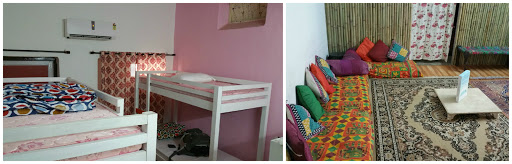
CrashPad is a hostel + hotel where they have built-in dormitories in personal house. It’s sort of a rip-off of Airbnb, but this is dirt cheap. When I saw the room they offered me, I was amazed. AC room, nice mattress with clean bed sheets and duvets, well-maintained plush hygienic bathroom. It was a 6 bed dormitory, but since I was the only tourist, so it was more of a private room. All of this at 500/- per day which included breakfast. I patted my back for this discovery.
In Jodhpur there is no sightseeing arranged by state tourism department (like Jaipur). But Ola cabs has a pretty good service here. After taking bath, I booked an Ola cab and headed out to Jaswanthada which is 1 km from Mehrangarh. Jaswanthada is a royal cenotaph built of white marble. A 1 km uphill walk and you would reach Mehrangarh fort.
 |
| Jaswanthada |
Mehrangarh fort was built around 1460 by Rao Jodha. Situated 120m above the city and surrounded by thick imposing walls, it houses some of the most beautiful palaces. Mehrangarh is a Rajasthani language version of Mihirgarh (Mihir means sun, garh means fort; meaning Sun fort). Mehrangarh fort has 7 gates, the prominent among them are Jaipol, Fatehpol and Loha pol. The museum inside Mehrangarh fort is the most well-stocked museums in Rajasthan. It exhibits the Rathore heritage in its full glory with an exalting collection arms, clothes, paintings, palanquins and many other stuffs.
 |
| Mehrangarh fort with a statue of Rao Jodha |
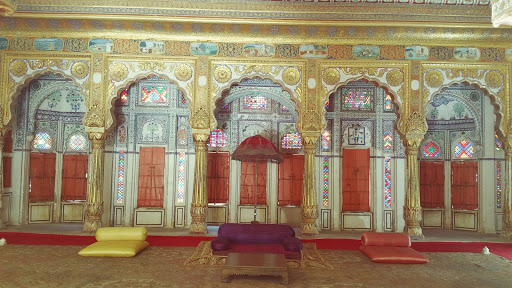
There are many palaces inside the fort complex – Moti Mahal, Sheesh Mahal, Phool Mahal and Zenana deodi. Moti Mahal was the hall of public audience. Its walls are lustrously polished and ceiling has gold embroidery. It has latticed windows for royal women to see day to day proceedings of court without being noticed. It has a beautiful eight-legged throne for the ruler with seats for noblemen on both the sides. Sheesh Mahal was private hall with equally embellished ceilings and walls embossed with tinted glasses.
 |
| Sheesh Mahal |
 |
| Top Left: Takht Vilas; Gold embroidered ceilings of Moti Mahal (Bottom Left) and Sheesh Mahal (Right) |
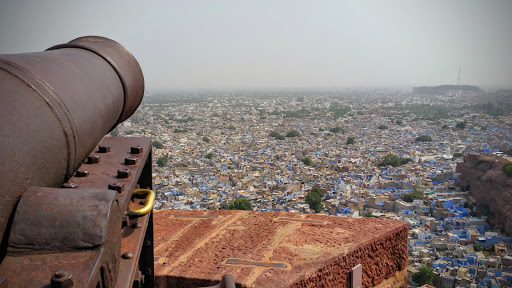
Takht Vilas, bed-chamber built by Maharaja Takht Singh, is also great crowd puller. The lacquer paintings on wooden ceiling and beautifully decorated floor which looks like a carpet speaks volumes about the patronage the artists used to get from Rathore rulers. Once you reach the top of Mehrangarh fort, you get to know why is this city called the Blue City. One can see the city of Brahmapuri mantled by a blue shade. It was beautiful. There are plenty of canons overlooking the entire city which bolstered the security of Marwar kingdom.
 |
| The Blue City |
 |
| Left: Way to Chamundat Mata temple on top of Mehrangarh; Right: The Blue City |
I came to know about ziplining tour conducted by Flying Fox out of Chokelao garden within Mehrangarh fort. If you book online, you get a discount of 25%. I did an online booking of the tour for a day later i.e. 1st July. Instead of actual price of 1800/-, I paid 1400/- as a result of that. After roaming a bit around the fort, I came back to my room by evening.
We first reached potter family. There was an elderly Muslim man sitting on a cot in the courtyard outside his hut. We greeted each other and had some random chat about each other. Then came a young boy (probably his son) and he explained me how pottery is done. Deepak used to interject our conversation with his inputs whenever he thought necessary. The young boy, created the base material which is a mixture of clay, gravel and saw dust. The saw dust is mixed so that, when the pottery is put in kiln, it burns leaving behind minute pores which causes the evaporation in clay pot leading to cool water. After rotating the wheel he put a lump of clay (plus gravel and saw dust) on it and with his deft fingers started giving it shape. Within a matter of few minutes, there was a beautiful a gullak (piggy bank) in his hands. Once he was done, he invited me to try my hands. I had thought that it was easy task, but was humbled. A slight mistake, and the clay will take a different shape. Only full concentration with right amount of pressure from hand applied surgically will result in a nice clay pot. What an amazing experience!!
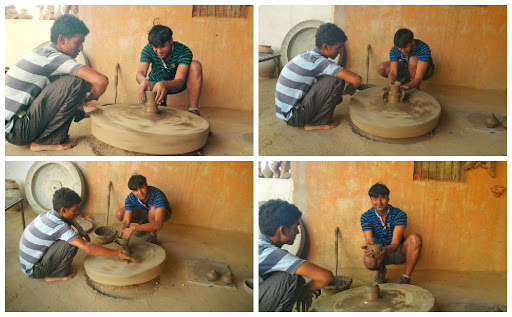 |
| Doing something creative with your hands is like healing !!! |
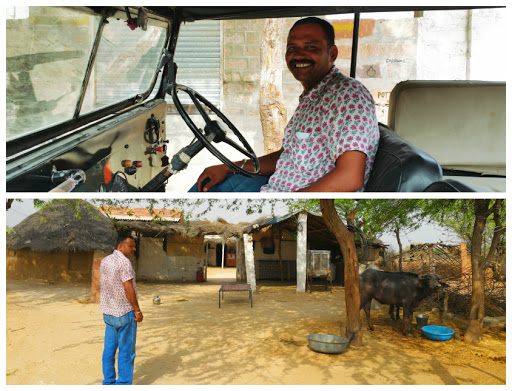 |
| Top: My guide Deepakji; Bottom: A Bishnoi hut |
After bidding adieu to potter family, we headed to meet Bishnoi family in Khejrali village. Khejri is a tree that is considered sacred because it grows on its own in this parched land. Bishnoi families follow 29 principles religiously most of which promote environmental stewardship. In 1730, 363 members of Bishnoi community laid their lives to save trees. They hugged trees to prevent its felling, and were subsequently killed by the soldiers. The ruler, Maharaja Abhai Singh, then apologized to Bishnoi community and ratified a law according to which no flora and fauna was supposed to be harmed in Bishnoi area. One of the Bishnoi person gave a demo of opium ceremony, which is a traditional ceremony of serving opium to guests. However, it was not served to me. It was just to showcase the rich cultural heritage of their community.
 |
| With a member of Bishnoi family |
From there, we moved on to meet weaver family. Seeing them weaving a carpet so meticulously was so exciting. When we see finished product, we usually don’t realize the amount of effort put into it. Most of the time we think that it must have been produced in a factory. But that is not always the case and it really humbles you when you see the amount of manual effort put into creating these items. This was the last lap of the safari/tour. We started our return journey. I requested Deepak to drop me at Umaid Palace instead of my hotel.
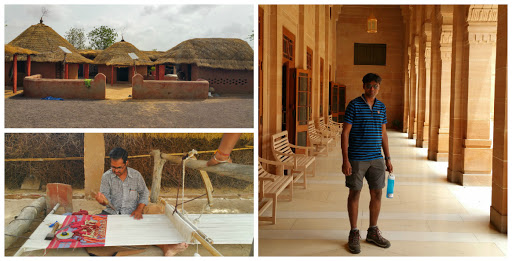 |
| Left: A weaver in action and his hut; Right: Inside Umaid Bhawan |
By this time, it was already noon and I headed back to my hotel. Thanks to Ola, I had a comfortable commute at a cheaper rates in hot sunny weather. I took bath and checked out of hotel at around 1.30 PM. The owner was kind enough not to charge for another day for staying extra 2-3 hours in the hotel. Once again Jodhpur’s hospitality impressed me.
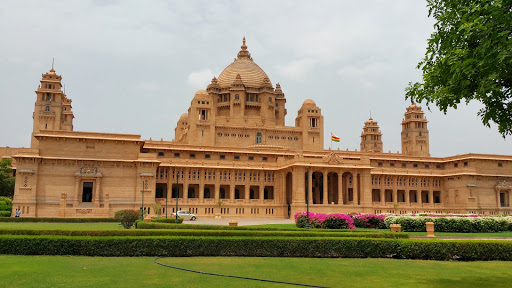 |
| Beautiful Umaid Bhawan |
I reached Chokelao garden in Mehrangarh fort at around 2.30PM. My ziplining slot was at 4.30PM, so I had another 2 hours left. I struck a conversation with a guard there and we talked for about an hour or so. He told me a lot about Rajputana, Marwar and their history. We sat in the beautiful chokelao garden and chewed the fat for almost an hour. Every day, at 3.30 PM in Mehrangarh fort, there is an amazing spectacle. A man, named Latif, feeds eagles from the top of the fort. This is an old tradition by Rathore rulers who believe that up until they continue feeding these eagles, their kingdom will be safe. However, no one is allowed to be near Latif when he performs this. I was in Chokelao garden at 3.30 PM when eagles started hovering above the fort. This according to that guard was the best spot to see this activity. Latif came at 3.30 PM and started throwing meat for eagles. Eagles somersaulted through the sky competing against their fellow brethren to win the prized flesh. This continued for almost half an hour. I was astonished to see the courage of that man. On one hand, I was scared every time any eagle lowered its altitude to catch the piece of flesh and on the other, there was this man, feeding eagles who were at an arm’s distance from him. This, by the way, is the reason why the hill on which Mehrangarh fort is built is called Cheel ka teela (Mountain of eagles).
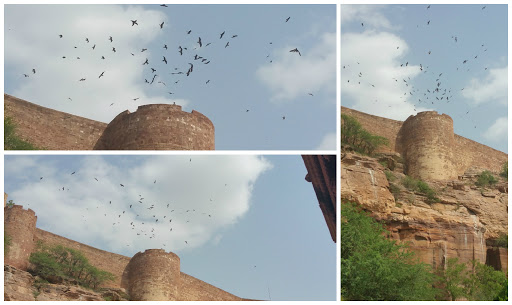 |
| Latif making eagles do acrobatics |
Whoaaa……………….s.i.l.e.n.c.e…………………the subsequent weightlessness made my stomach go upside-down, my heart stopped, my lungs broke the ribs and reached my mouth………………… AAAAAAAA ………… I shouted my lungs out; not once but multiple times.
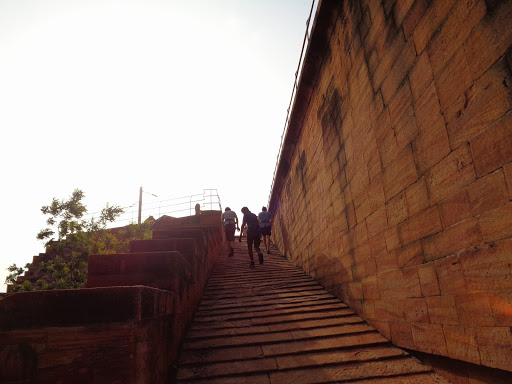 |
| Fil, Walt and I on our way to first zipline |
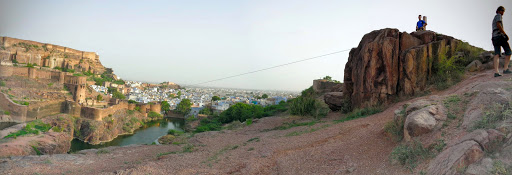 |
| One of the longest ziplines |
I was done with ziplining by 6 PM and was craving for some food. I took an auto and headed once again to Mishrilal’s shop to have yummy mirchi bada, mawa kachori and lip-smacking makhaniya lassi. After filing my stomach, I walked down to railway station to head Jaisalmer.
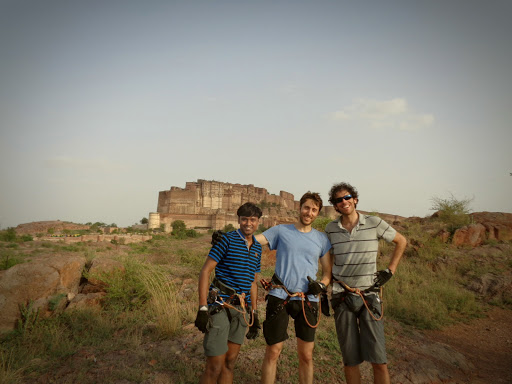 |
| I, Fil & Walt (Left to Right) |
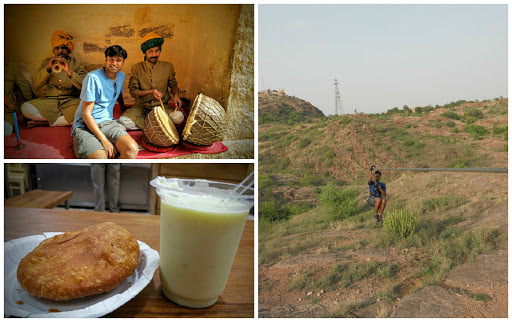 |
| Jodhpur treats – Mehrangarh fort, Ziplining and Makhaniya Lassi |
 Abhijeet Kumar Sinha