I took the bath and went to see Jaisalmer fort, or Golden fort, or Sonar Quila, which was at the walking distance from my hotel. This fort, unlike other forts in Rajasthan (except Chittaurgarh) is a living fort. People stay inside the fort as they used to during earlier days. Jaisalmer is named after Maharawal Jaisal Singh, a Bhati Rajput king who founded the city on 1156 AD. This fort, built on Trikoota hill by Maharawal Jaisal, is constructed completely from yellow sandstone and shines with resplendent golden color when sun light falls on it. Because of lack of water in this area, the stones are not joined by mortar, rather an interlocking system was used which saved lots of water. Grove was formed on one stone and other stone was fitted firmly inside it. There are 4 “prols” or gates inside this fort.
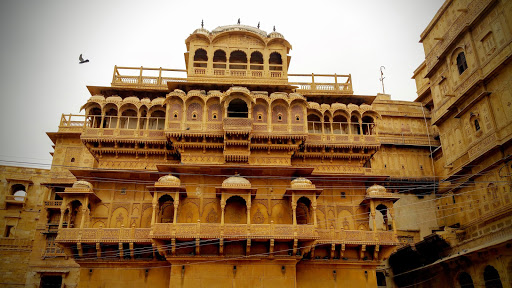 |
| Palace for royal women within the fort |
 |
| Sonar Quila – a living fort |
 |
| Left: Interlocking of stones used in construction ; Right: Wooden ceilings in fort for keeping the fort cool |
There are 7 Jain temples inside the fort which was built by rich Jain merchants between 12th to 15th century. This jain temple houses 6666 statues of Jain tirthankars. The significance of 6666 is that 6+6+6+6 is equal to 24 which is also the total number of Jain tirthankars. At the entrance of the temple itself one can see fossil stone, which according to an age old tradition is believed to keep away negative spirits. This is the reason why one can find fossil stones in various Indian monuments. There are 3 prominent types of stones found in Jaisalmer – yellow sandstone, limestone and fossil stone. The abundance of fossil stones in Jaisalmer gives strength to a popular belief that once Jaisalmer was completely inside sea and then sea dried exposing the arid land.
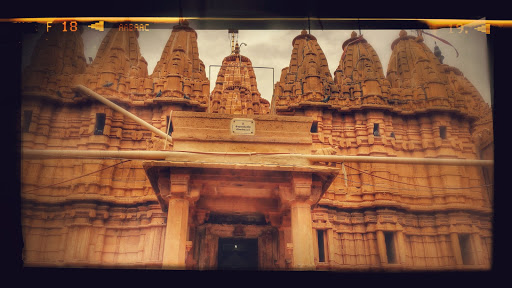 |
| Jain temple |
 |
| Exquisite carvings in Jain temple |
After visiting the fort, I took my lunch and came back to the hotel. Camel safari is something which anyone has to do when in Jaisalmer. Returning from Jaisalmer without enjoying their camel safari is a crime J. I called a few tour operators but either they were denying saying that they don’t have any group going or were asking for exorbitant prices. Finally after an hour of frantic phone calls I ended up with Sahara Travels which had a group of 4 French people going on camel safari and he agreed to accommodate me at 1500/- . The price was definitely high considering the off season but I didn’t care much as I so much wanted to do this. The owner of Sahara Travels was generous enough to send a person with bike to receive me from my hotel and take me to their office to make the payment and do the formalities. I paid some advance amount, gathered some details and came back to the hotel. I was asked to be back there at sharp 3 PM.
Our first stop was a haunted village known as Kukdhara village. The folklore says that some 300 years ago Paliwal brahmins used to dwell here. The prime minister of king, Salim Singh, fell in love with daughter of the village head. He asked them to either give her hand or leave the place. Brahmins being too rigid when it comes to inter-caste marriage refused to be subjugated. It is said that some 84 villages got vacated in one night. But before they left their villages, they put a curse here that no will be able to inhabit this place once again. To this day, Kuldhara village has remained as it is, the way it was left. People trying to stay here have been chased away by paranormal activities and have reported hearing wails of children and women leaving their houses.
 |
| The abandoned, ghostly Kuldhara |
 |
| Top: Ruins of Kuldhara; Bottom: Govt. renovated portion of Kuldhara for tourists |
Chapter 3 : The ethereal Camel Safari
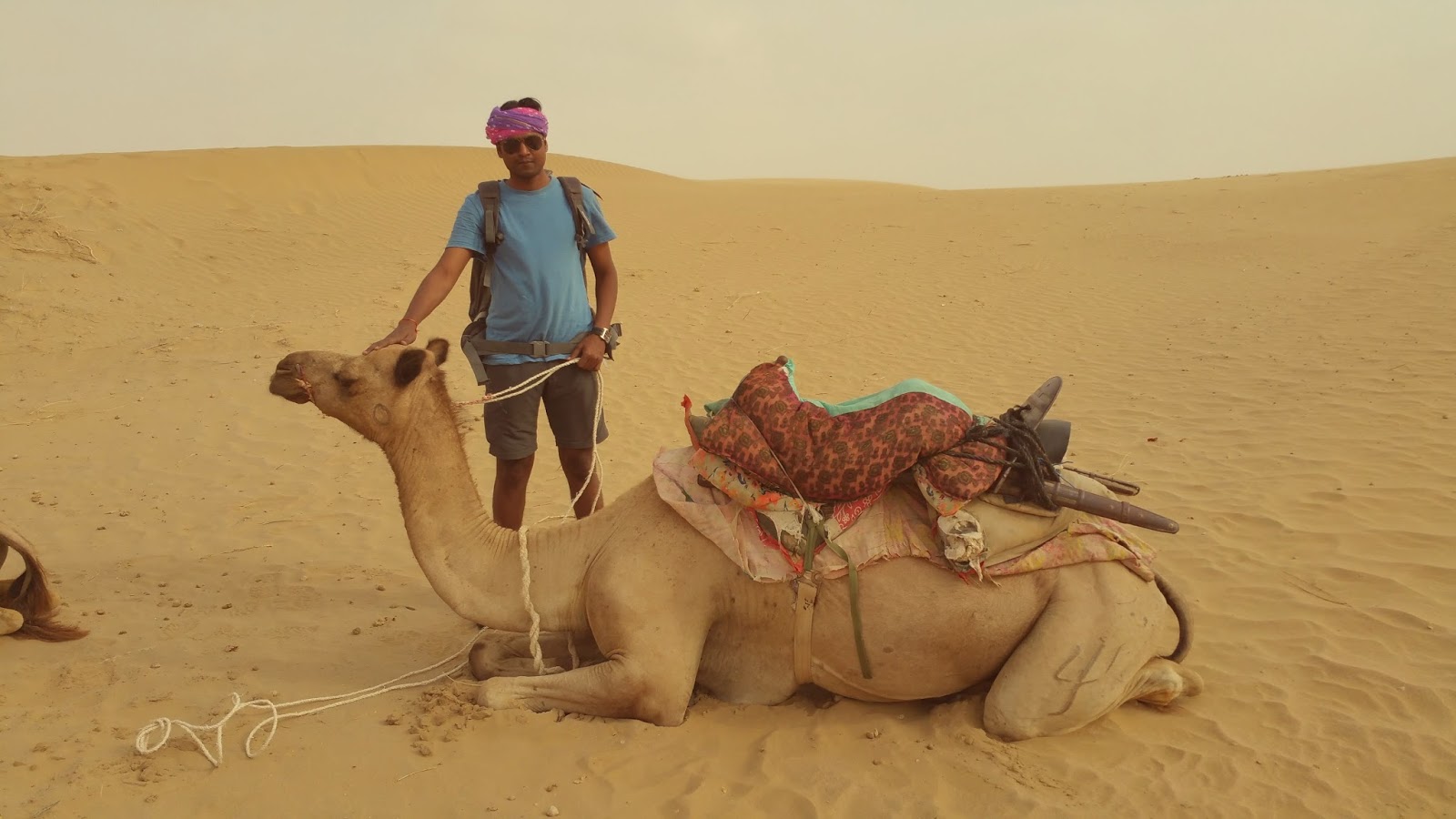
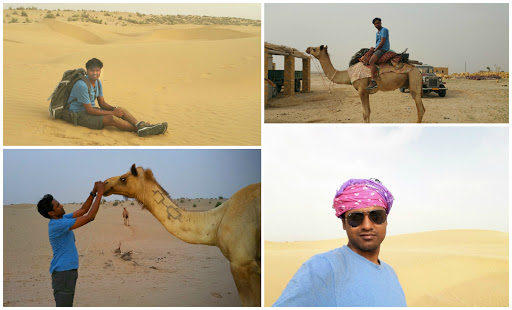
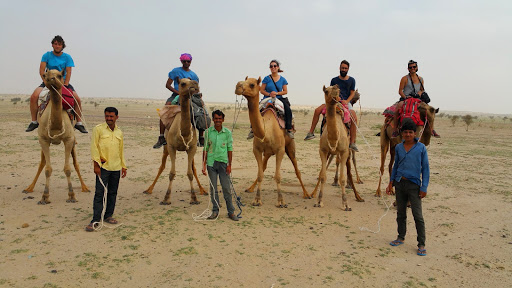
There were 2 porters accompanying us – Kalu and Shambhu. Our jeep driver, Manu, along with another guy, Sawai, took the jeep with him to meet us at the camping location. We hopped on the camel back with our backpacks hooked to the saddle, a bottle of water in hand and sunglasses to protect the eyes from the sand and sun. We were all set to venture into one of the most beautiful voyage of our life.
 |
| My Safari buddies |
Initially when we started, there were plain fields dotted with green shrubs, thanks to the rain that had happened a few days ago. This gave way to fresh tilled lands where farmers would grow millets, staple food of Rajasthan. There were also glimpses of sheep and cows grazing the land. One could see some brown mud huts with thatched roofs pockmarking the yellow surrounding with some green grasses and grey thorny shrubs adding some extra hue to the canvas. And then there were sand dunes, the never ending sea of sand. My ride was a potpourri of landscapes this beautiful planet has to offer.
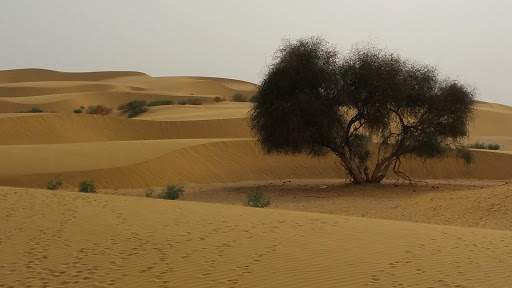

Sun was about to set and I went on a walk. Thar had an apollonian ambiance disturbed only occasionally by cud chews of camels. It was an experience in itself lying on sand under clear reddish sky and watching the sun drowning in the yellow sea in front of me.
 |
| Strolling through the unconfined, silent, yet majestic sand dunes |
Once everybody was done with dinner, all the 4 helper guys settled in front of us with their “musical instruments” – water canister and steel plates. They sung a few folk songs for us. I also sang a few songs. This carried on for almost an hour and then our beds were made with home made mattresses and duvets.
 |
| Kalu, Shambhu, Manu and Sawai in action |
We once again packed our bags, put it on camels and returned to Barna at around 10 AM where Manu was waiting with his jeep.
 |
| The last one together |
I came back to hotel at around 11.30 AM, took my bath and checked out at 1.30 PM. Mr. Polu was kind enough not to charge me for an extra day as their check out time was 10. I went to Gopa chowk near Jaisalmer fort, ate my lunch and walked my way to Patwon ki haveli. There are 5 havelis built by Guman Chand Patwa, an insanely rich Jain merchant, for his 5 sons. These havelis are beautifully sculpted. Each and every piece of stone has been meticulously worked on. The lavishness of these havelis are evident from the fact that Patwas used to loan money to kings and kingdoms, not just normal people.
 |
| Patwon ki haveli |
 Abhijeet Kumar Sinha