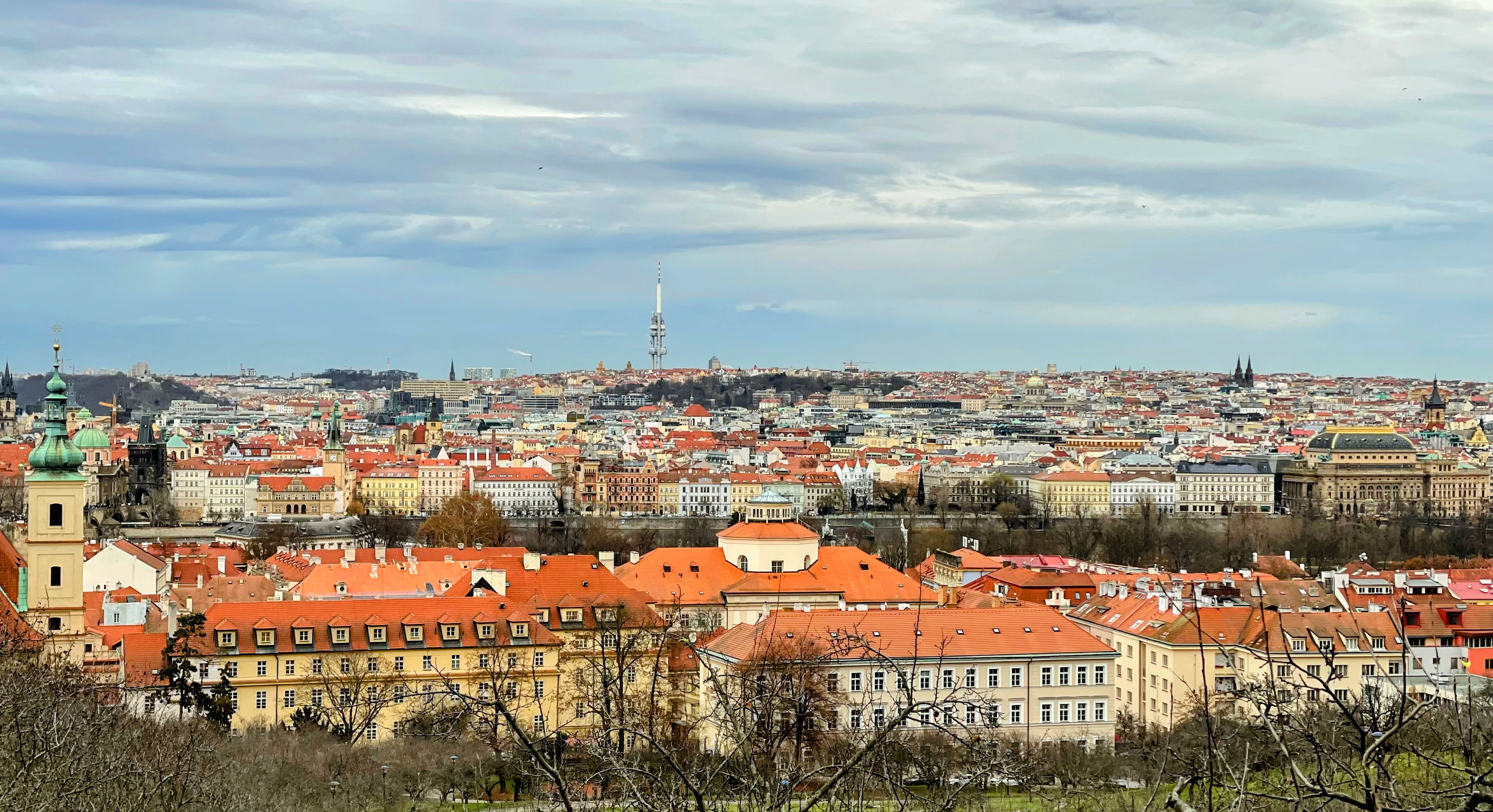
My trip to Central Europe started with the city of hundred spires – Prague. Stepping foot onto some of the prettiest cobblestone streets, strolling through the vast complex of medieval castles, walking down the aisle of gothic and baroque churches and gazing up the pastel-colored buildings with incredible paintwork, Prague has got it all. Amidst centuries of history written at every nook and corner, Prague also offers a unique opportunity to get intertwined in its spiral chimney cakes, dig into decadent cakes and lose oneself in the festive vibes of its energetic Christmas markets. It has a magic woven into it.
History of Bohemia/Prague
During the Iron Age one of the Celtic tribes called Boii tribe inhabited this place. Hence this land is also called Bohemia.
Premyslid dynasty (9th century to 1306)
Premyslid dynasty was the first historically documented line of royals to rule over the duchy of Bohemia and Moravia starting with duke Borivoj I. He established his seat on a rocky ridge over Vltava River in 880 AD, a spot that was perfect for future Prague Castle. He converted to Christianity in 883 along with his wife Ludmila who became the first saint of Bohemia. Their grandson, Wenceslas I (or Vaclav in Czech) who ruled between 921 and 935 AD was one of the most important rulers of this dynasty and also a patron saint of Bohemia. He was assassinated by his brother. His heroic virtues made him popular and was posthumously made patron saint of Czech state, thus becoming St. Wenceslas. You will see statues and portraits of Ludmila and Wenceslas all across Prague.
Duchy vs kingdom vs empire
Before 1085, Bohemia was a duchy. A duchy is lesser than a kingdom (which is further less than an empire) in terms of size and population. Duchies are portions of larger kingdoms with their leaders, known as the dukes, following the command of their king.
In 1085, Bohemia became a kingdom and Vratislav II became the first king of Bohemia. The kingdom reached its height under Ottokar I who fought several wars and acquired Hungary and Austria. Premyslid’s line died with Wenceslas III in 1306. Wenceslas III’s sister was Elizabeth of Bohemia who was married to John of Luxembourg. After the death of Wenceslas III, the Bohemian throne passed on House of Luxembourg.
Luxembourg (1310-1437)
John and Elisabeth’s son was Charles IV, the holy Roman emperor. He made Prague Castle his main seat. Charles University, Charles Bridge, Prague Castle, St. Vitus Cathedral and many other architectures of Prague are attributed to him. Charkes IV reign is considered the golden age for Prague. The trend continued during his son Wenceslas IV’s reign and Prague became an important European capital.
Jagiellons (1471-1526)
For a period during Hussite Wars, Bohemian throne went to Hussite leaders most importantly Geroge of Podebrady. Thanks to his alliance with Jagiellons, the next king of Bohemia was Vladislav in 1471 who ruled until 1516. But his line died out with his son Ludvik (aka Louis II) who died in the battle of Mohacs with Ottomans led by Suleiman the Magnificent in 1526.
Habsburgs (1526 -1918)
After the death of Ludvik (aka Louis II) in 1526, kingdom of Hungary seized to exist for all practical purposes as Ottomans captured most of it. The Bohemia fell in the hands of Habsburgs as Ludvik didn’t have an heir. His sister Anna was married to Ferdinand I from Habsburg dynasty (also became Holy Roman Emperor later). Habsburg dynasty ruled this land until the formation of Czechoslovakia at the end of 1st World War.
Czechoslovakia (1918-1989)
The victors of the 1st World War drew boundaries all across Europe and created the Czechoslovak Republic in 1918. After Munich agreement in 1938, just before the start of the 2nd World War, Hitler occupied Czech part of the Czechoslovakia and made it its protectorate. Slovakia was made an independent country with a puppet ruler. After the 2nd world war, the country was reunited to form Czechoslovakia, but it fell into the hands of USSR and became a communist state. The velvet revolution in 1989 ended the communist rule and restored democracy.
Czech Republic (1993 to present)
On 31st December 1992, Czechoslovakia was peacefully dissolved to form two independent countries – Czech Republic and Slovakia. This is also called velvet divorce.
Growth of Protestantism
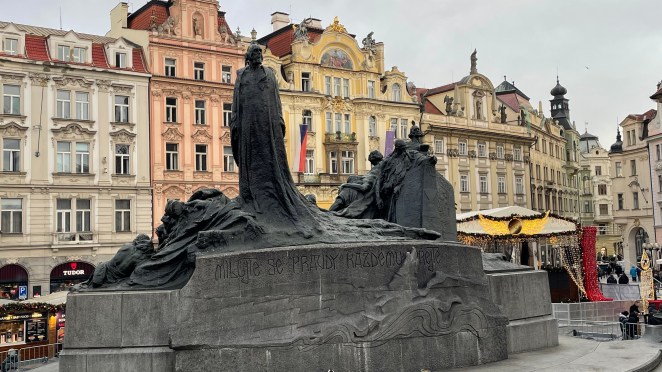
Prague was the birthplace for church reform. Led by Jan Hus who started Hussite movement which is considered by many as the predecessor to Protestantism. In 1403, Jan Hus became the rector of Charles University. He espoused anti-papal teachings of John Wycliffe. Around that time, there was a prevalent practice of paying church to get rid of one’s sins. He preached against such sale of indulgences and espoused Bible to the sole authority in all matters of belief (not pope). This of course didn’t go well with Church, nor with the king who received a percentage of that money. Jan Hus was declared heretic and burned at stake in 1415.
But his death sparked Hussite wars which his followers fought with Catholic forces of Holy Roman Emperor Sigismund (son of Charles IV). Although the Hussite movement was crushed eventually, it paved way for rise of Protestantism a century later which was led by Martin Luther.
Public transportation in Prague
If you are staying near Old Town Square, most of the places are walkable. If you want to go somewhere farther, using public transportation is the best option. You can download PID Litacka app. This app helps you get the best route for going between point A to B within Prague. You can also use the app to purchase a single use ticket (30 CZK) or 24 hours pass (120 CZK). We purchased 24 hours pass as it gave us the flexibility we wanted to roam around.
Day 1, Dec 17th 2024
It was supposed to be a boring day which was comprised of we taking a couple of flights and then a train to reach Prague by end of the day. But unfortunately, it turned out to be quite eventful.
First, our flight from Seattle to Amsterdam got delayed on 17th morning. As a result, we almost missed our connecting flight from Amsterdam to Frankfurt. We literally had to run on Amsterdam airport, cut lines to get the immigration done and pushed people around to reach our boarding gate just on time.
When we reached Frankfurt, we waited for almost 40-50 minutes for our luggage. We checked our luggage airtags, which showed that it is not in Frankfurt. But we thought that it may be some error. After almost an hour, we went to Lufthansa baggage service at the airport. By the way, finding their baggage center is a story in itself. There is no sign board for Lufthansa at baggage claim area. We had to go to an adjacent hall, buzz a button to tell our problem on intercom which opened door 1, and then repeat it to open another door to reach Lufthansa baggage help desk. Seriously! Now once there, I told my problem. The gentleman there in a very nonchalant way told me that waiting for 40-50 min for baggage is normal at Frankfurt. I was aghast!
Finally, Lufthansa confirmed what I feared. Our luggage was left at Amsterdam. They filed the delayed baggage report and assured me that it will reach our hotel in Prague. Lufthansa reimburses full amount of the cost incurred for toiletries and innerwear, while 50% of any other clothing.
I was glad that I had kept 3-4 hours buffer between our arrival in Frankfurt and the train to Prague, otherwise I would have missed that for sure.
Anyhow, we followed the signboard to take regional trains S8 or S9 on the airport. At the ticket vending machine I took a local person’s help to purchase single-trip journey ticket to reach Frankfurt Main train station. It was €6.3 per person. We reached Frankfurt Am Hbf around 1 PM where we waited for 1.5 hours to take our train to Prague.
Our train journey to Prague had 1 stop – Frankfurt to Regenburg and Regenburg to Prague. Frankfurt to Regensburg train got delayed by more than 30 minutes. Thankfully, my layover at Regensburg was 1 hour, so the delay didn’t impact me. But being new to all this in a new country, you of course get concerned at the beginning.
The train stations of Europe look old from outside but interiors are very well renovated with modern amenities. They all have free Wi-Fi – not just the station but on trains as well.
Important tip –
(1) Keep buffer time between different legs of your journey. Especially when you are new to a place.
(2) Just for my knowledge, I checked the current ticket price for Prague at Frankfurt train station. It was €280 for 2 people with Deutsche Bahn. I had pre-booked my ticket online about a month in advance for just €85. That’s how much of a difference it could be.


Day 2, Dec 18th 2024
Walking tour
I booked a free walking tour. Generally, a walking tour is a very fantastic way to get an overview of the history and top sightseeing places of that city. It gives you a fair idea of what to do or prioritize in next couple of days and is quite cheap (tip-based). If you have already done some prior research, the walking tour guides can clarify your doubts or give good tips.
As part of walking tour, we saw Powder Tower, Old town square, Astronomical Clock, Jewish quarters and ending the tour at Rudolfinum. This 2.5-hour tour equipped us with a lot of historical information which was helpful in the next 3-4 days of our stay in Prague. Our guide Teresa also gave us info on good restaurants and cafés to try out in Prague.
Christmas market
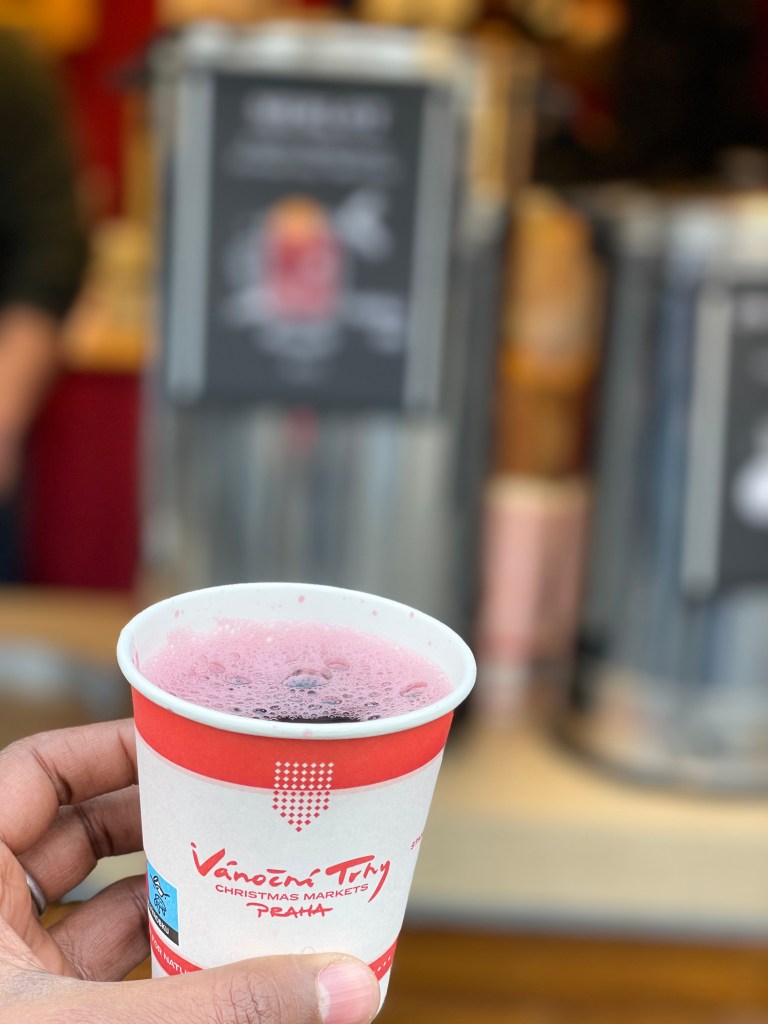
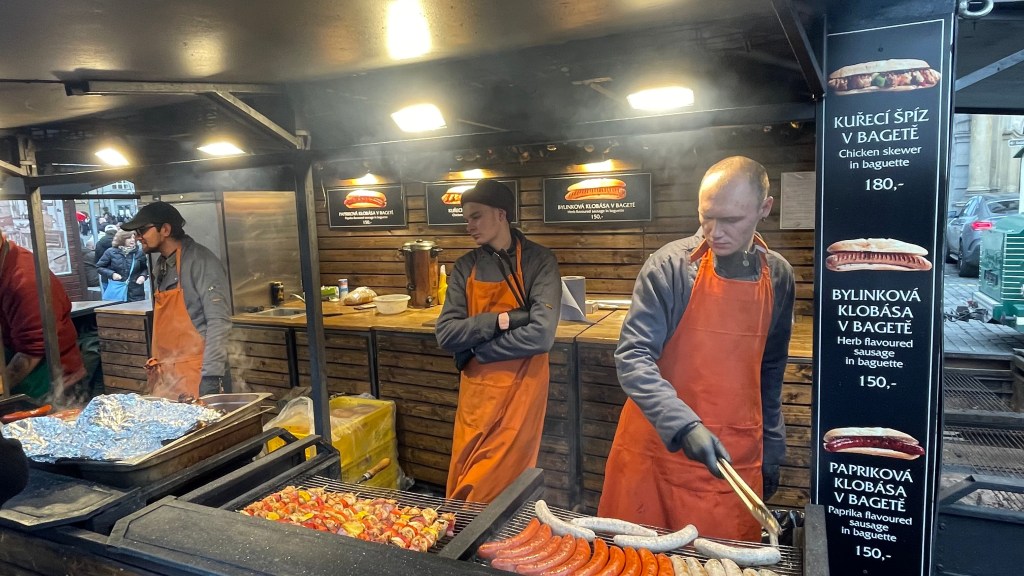
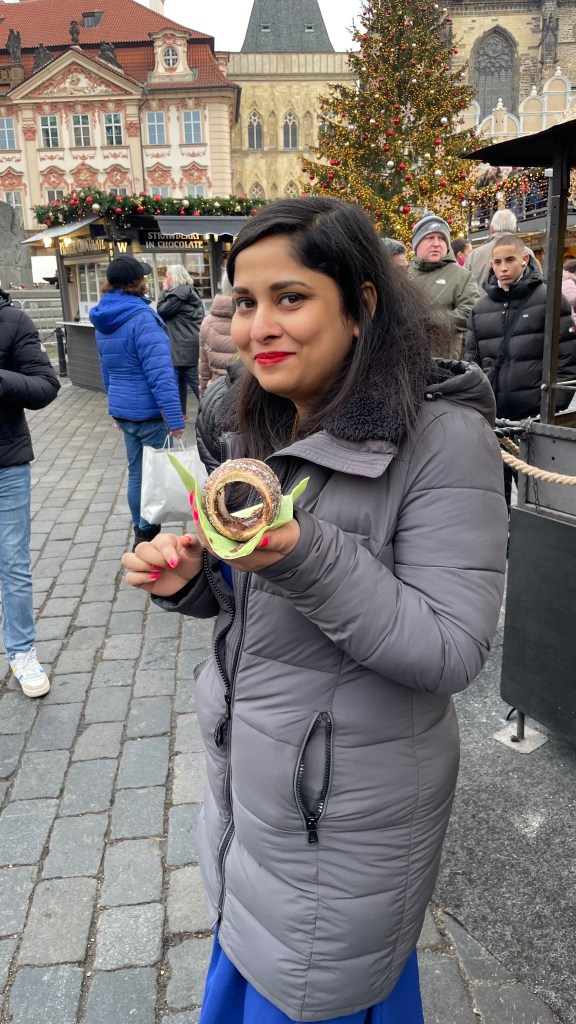
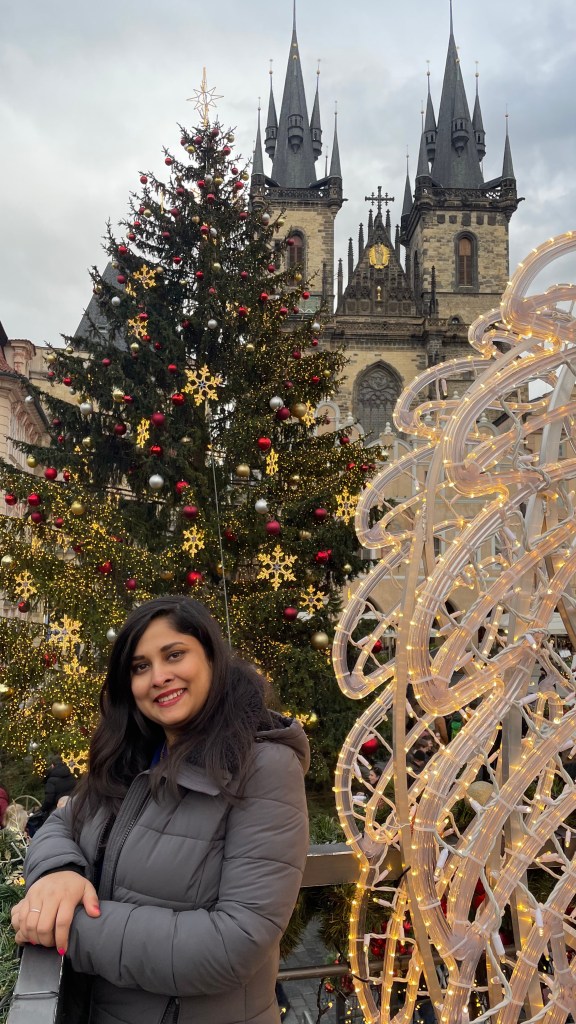
The walking tour ended around 1 PM. We walked from there to the old town square of Prague which is where the Christmas markets are held. The Christmas markets in Prague are a dazzling spectacle, with wooden stalls lined up along the cobbled streets, adorned with twinkling lights and festive decorations. The air is filled with the scent of mulled wine, roasted chestnuts, traditional Czech pastries and sausages. The vibrant atmosphere, complete with cheerful music and the glow of Christmas trees, creates an unforgettable festive vibe, drawing both locals and tourists into the heart of the holiday season.
We tried chimney cake, mulled wine and sausages. I must say that mulled vine is really strong than what I expected. Due to it being heated, the strong aroma of vine fills your nose much before you take a sip. So, be prepared!



Palladium
After spending about a couple of hours at the Christmas market, we headed to Palladium shopping mall. Our luggage had not come yet. Lufthansa had promised that they would reimburse 100% for toiletries and innerwear and 50% for other clothes. So, we went to Palladium to buy some necessary stuff.
Overall, I think Palladium shopping mall is quite pricy because it is located in the heart of the tourist zone. I wouldn’t shop from here if I had to pay from my pocket. I think Wenceslas Square (which we visited on 20th) would be a better choice. Or find other places where locals do shopping from.
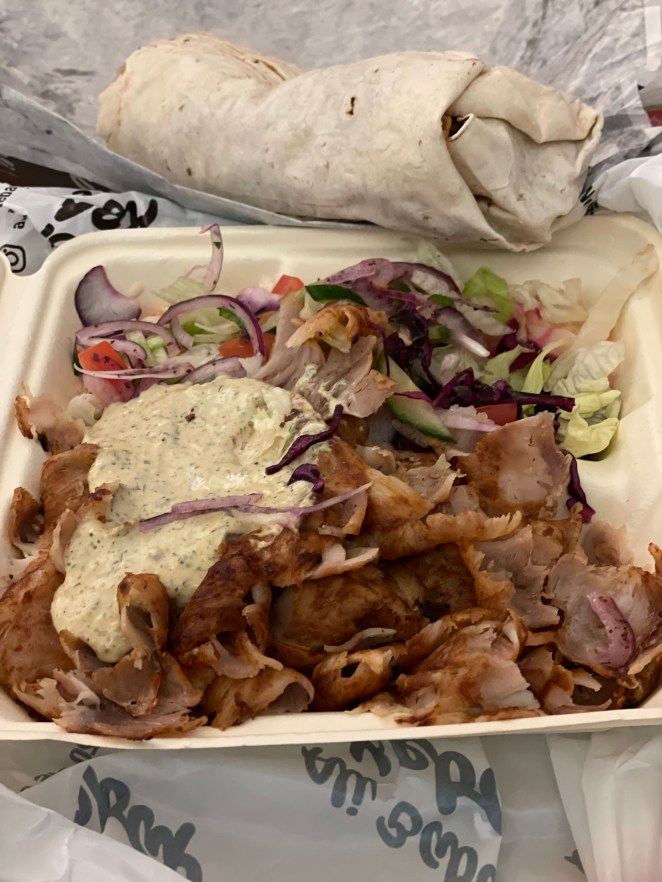
We didn’t have energy to dine outside. So, we went to a Turkish restaurant nearby and took out doner kebabs and had a relaxing dinner at our hotel room.
Day 3, Dec 19th 2024
Prague castle complex
Prague Castle is not one building but a group of buildings with different styles brought together within a complex on a hill overlooking the town. Dating back to 9th century, it is home to a number of significant structures like Gothic-style St Vitus Cathedral, Old Royal Palace, St. Geroge Basilica, the color Golden Lanes and many more. It is the largest ancient castle complexes in the world spread over an area of 70,000 sq meters. It is mostly rectangular in size stretching about 570 meters in length and 130 meters in width.
The castle complex is open at 6AM but other buildings open at 9 AM. We were at the castle before 9 AM so as to avoid the crowd. But still many tourist groups were already present. Still the queue at the ticket counter was not very long. I like to visit at my own pace. So, instead of taking a private tour with a guide, I took my own ticket and paid for an audio guide. This, by the way, was cheaper than the private tour guide. Ticket information can be found here – Tickets – Prague Castle for visitors. I took the ticket for main circuit (450 CZK) and audio guide (350CZK), a total of 800 CZK per person.

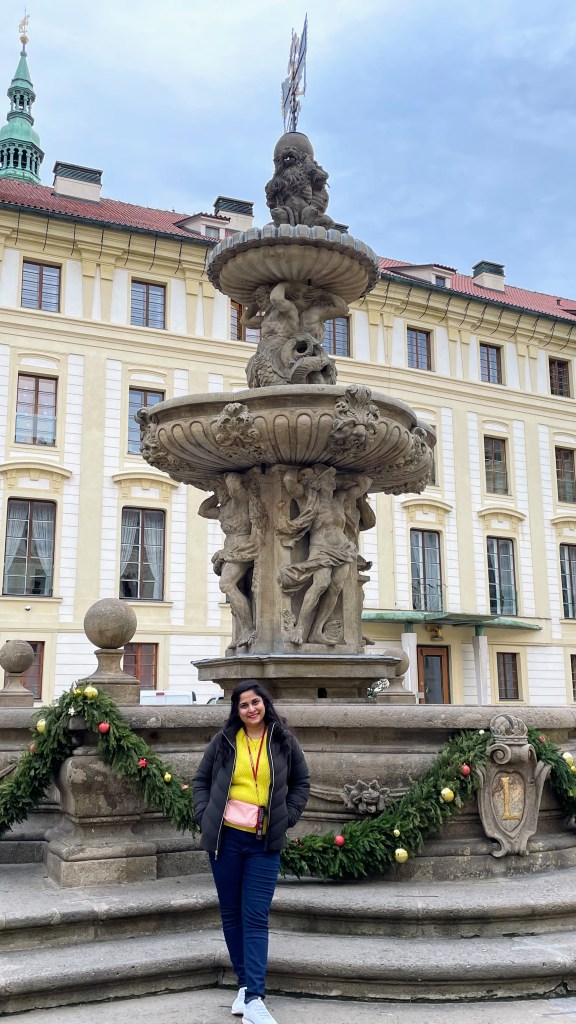
St Vitus Cathedral
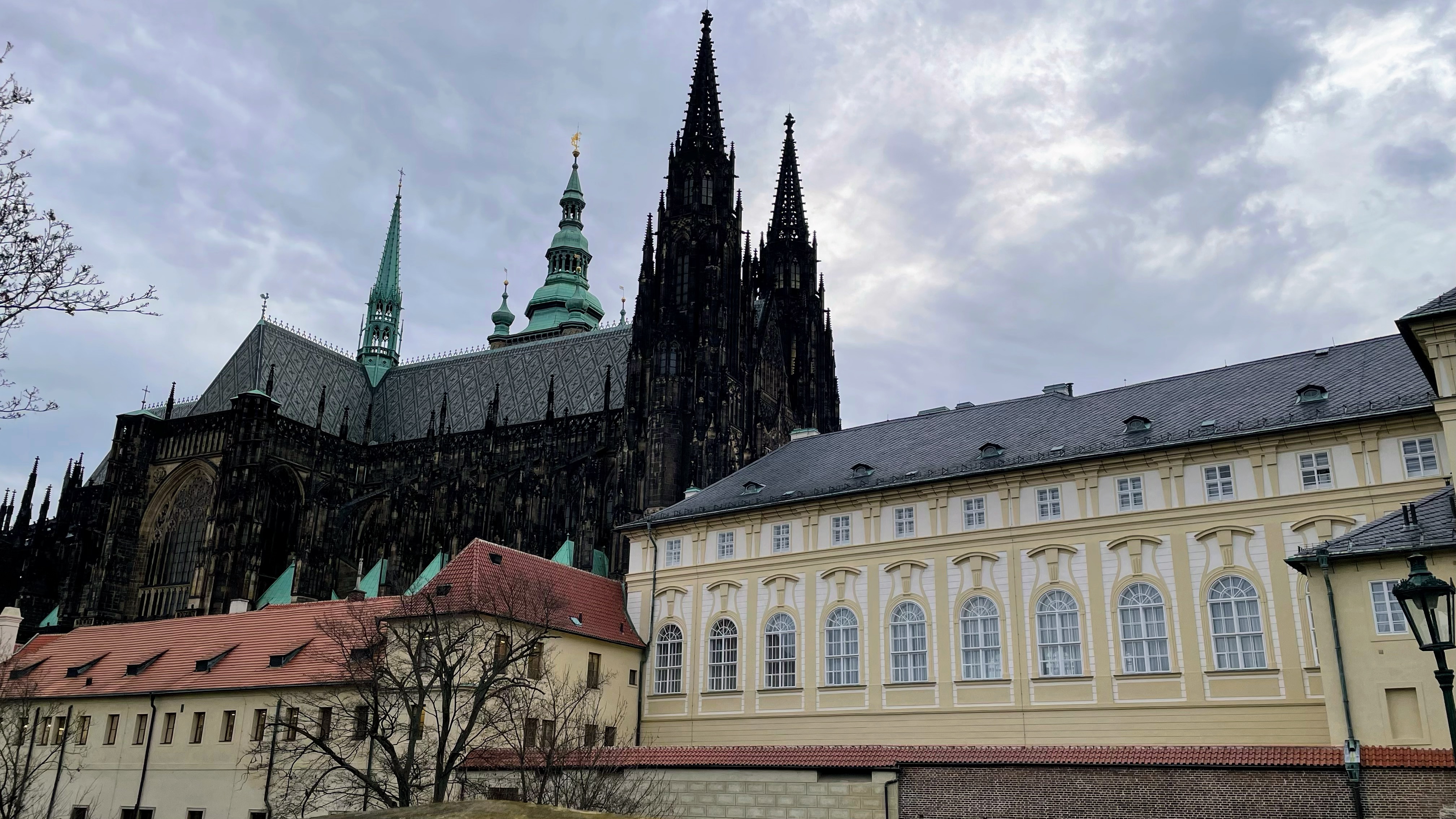
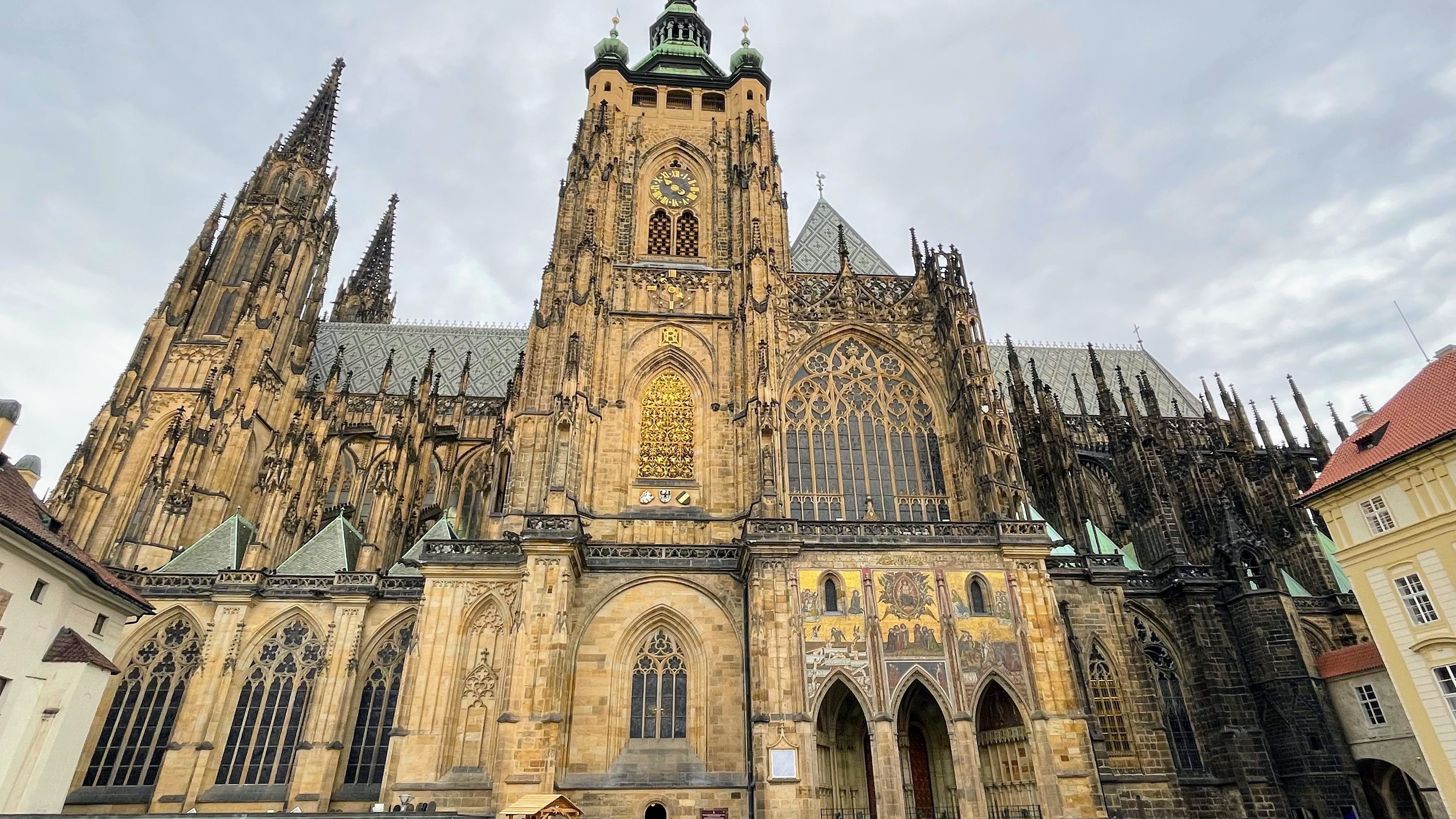
St. Vitus Cathedral is a roman catholic cathedral and the seat of the Archbishop of Prague. The main tower of this magnificent Gothic masterpiece stands 102 meters tall while the front towers are 82 meters high. The height of the arch inside nave is 33 meters.
The foundation stone of a church at this location was laid by Wenceslas I in 930 AD. It was a Romanesque rotunda. Construction of present-day Gothic cathedral was started by King John of Bohemia 1344 AD. It was further patronized by John’s son Charles IV, the Holy Roman Emperor, who intended this cathedral to be a coronation church, family crypt, treasury of crown jewels and last resting place of St. Wenceslas (aka Wenceslas I). Work at the cathedral, however proceeded slowly and was interjected by Hussite wars, lack of funds and lost interest for many centuries. Through most of the centuries, the cathedral stood half finished. It was built to a great tower and a transept with a timbered roof construction. It was finally completed in 1929 on 1000th death anniversary of St. Wenceslas, almost 600 years after its construction started.
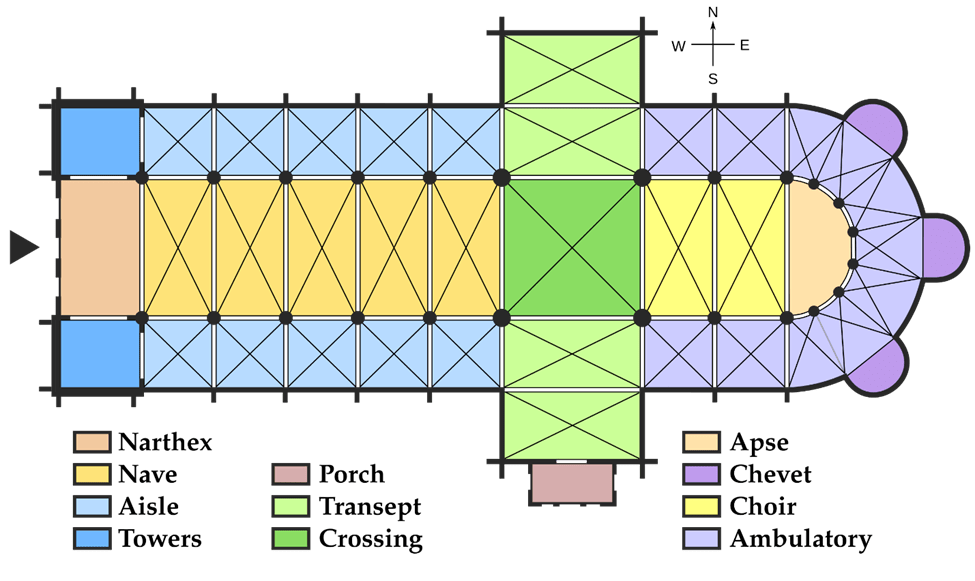
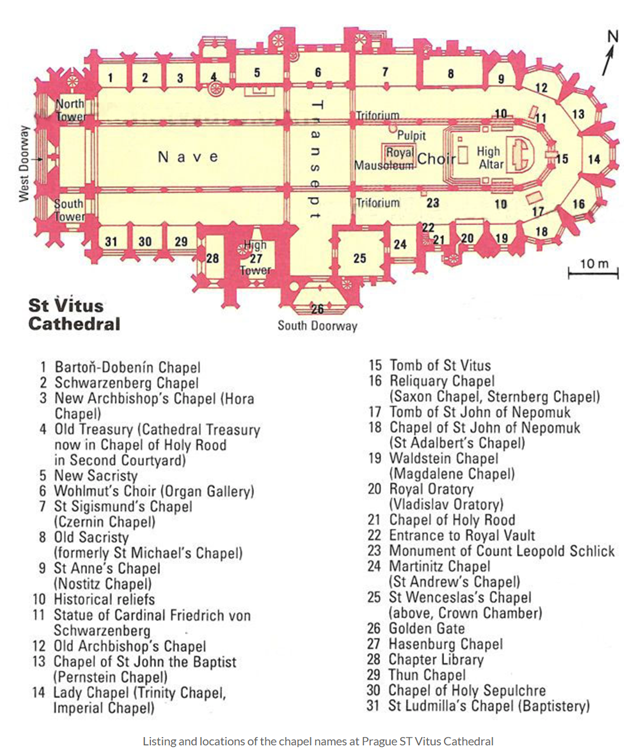
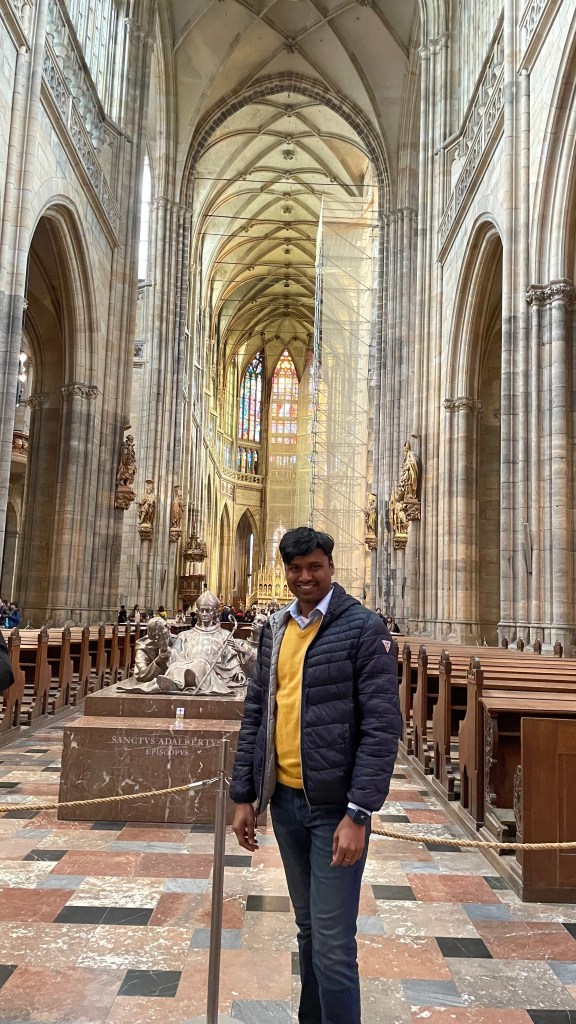
As you enter St. Vitus Cathedral, you will notice that there are several chapels lined up on both the sides of the aisles. The picture below shows the layout of St. Vitus Cathedral today including the names of the chapels. We entered the cathedral from West entrance and visited it in anticlockwise direction starting with Ludmila’s chapel. The things that grabbed my attention were high ribbed vault ceilings. These rib vaults were one of the essential elements that made high ceilings and large windows possible in Gothic architecture. Further into the cathedral is the Wenceslas chapel which is the most decorated one. There is also an adoration of John of Nepomuk which was added here in 18th century.
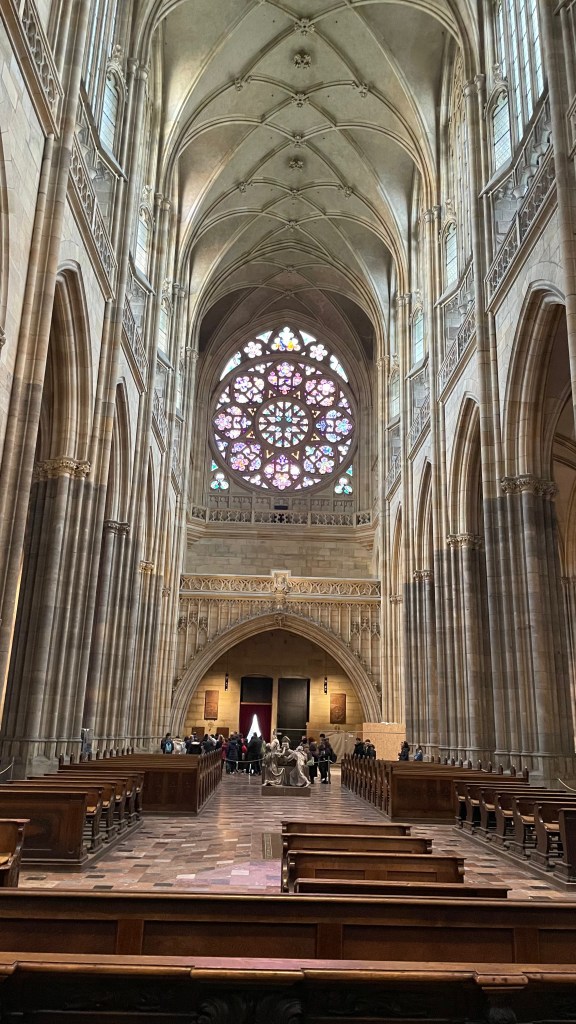
As you look at the nave from West entrance, you can see the tomb and raised silver motif of St. Adalbert. Situated in the chancel of the cathedral, in front of the high altar is the white marble royal mausoleum built in 1589. Many important monarchs including Charkes IV, Ferdinand I and Maximilian II are buried in the crypt below this mausoleum.
The stained-glass windows of have didactic purposes. Not only do they add an eclectic charm to the cathedral, but they also tell stories of Jesus and other saints of Bohemian region.
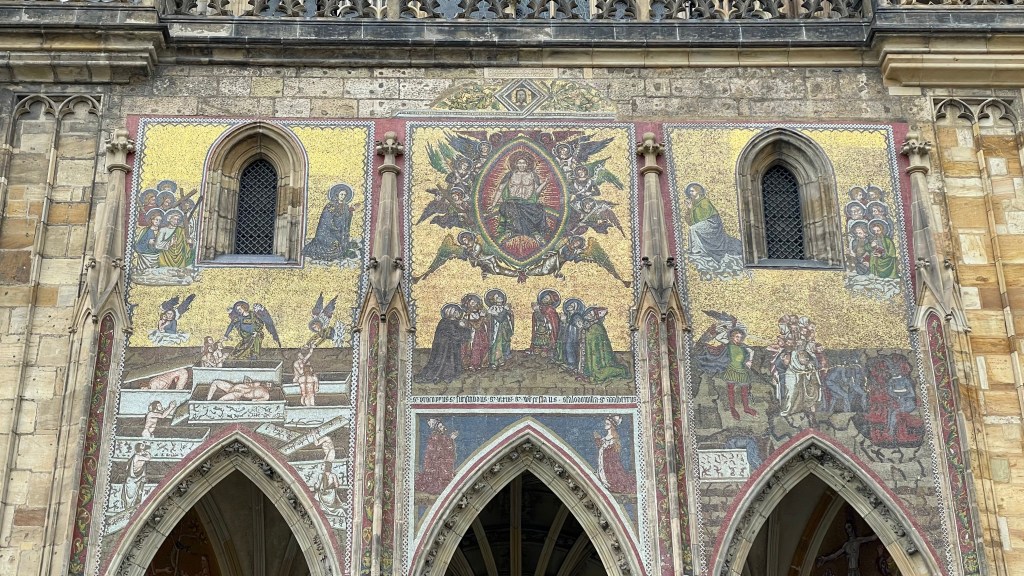
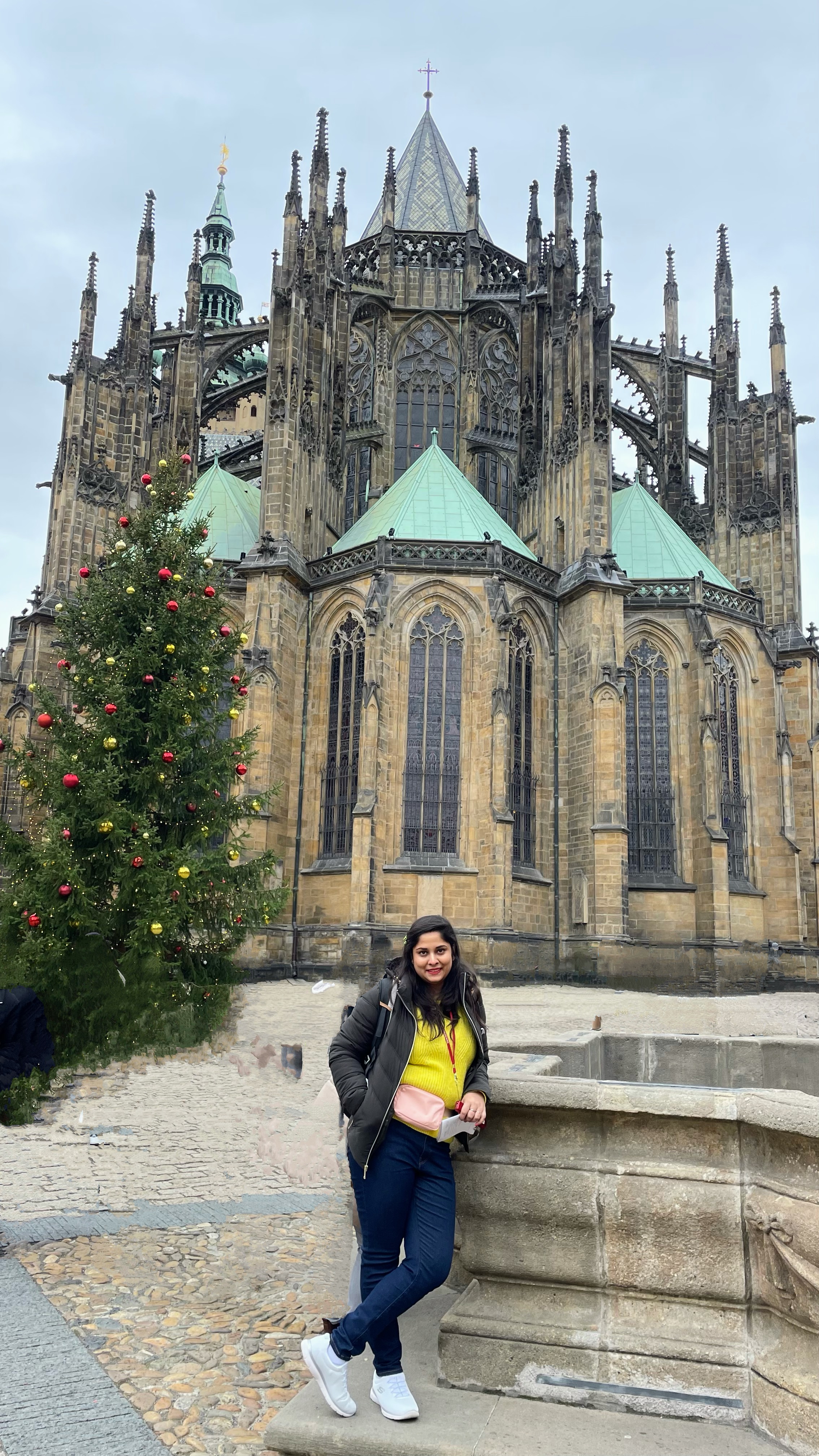
When you get out of the Cathedral and walk along its southern walls, you get to see the “Golden Gate”. It is called as such because of exquisite golden mosaic work on its southern doorway depicting The Last Judgement. It is through this doorway that kings entered for their coronation. From here, you can also clearly see the flying buttresses which support the weight of those high rib-vaulted ceilings.


Old Royal Palace
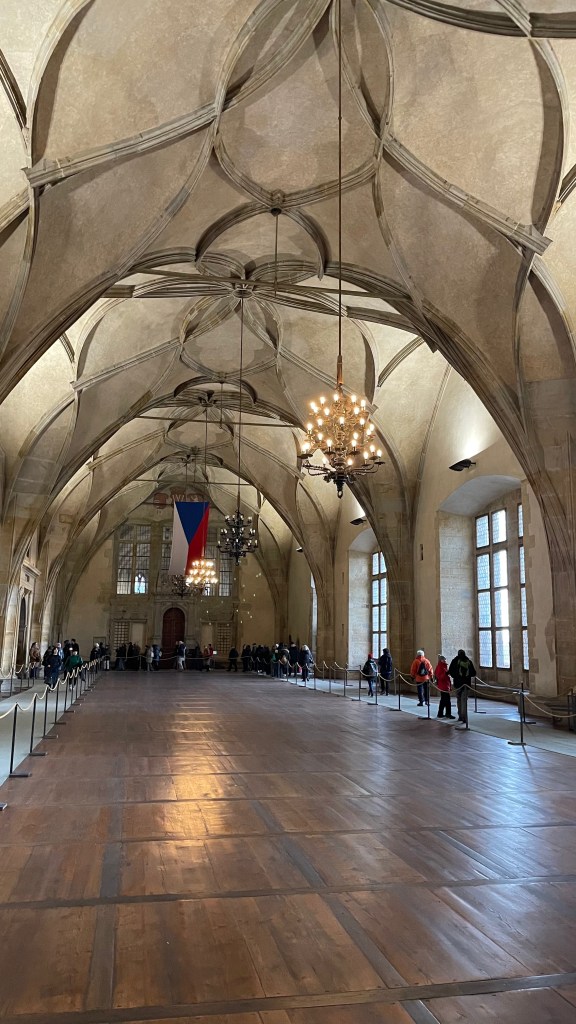
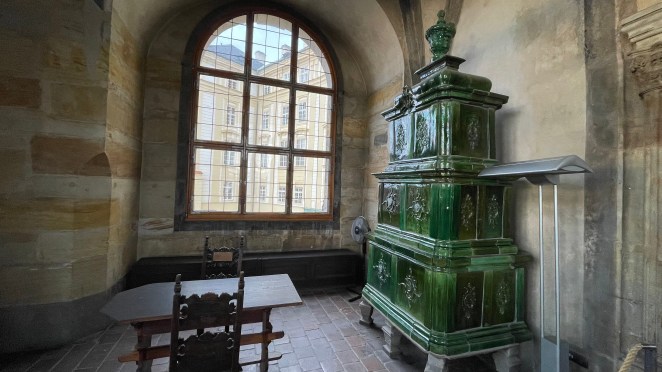
The foundation stone of a Romanesque stone palace was laid in 12th century. During the time of emperor Charles IV, this palace was enlarged and new Gothic elements with vaulted ceilings and arcades were added to it. The palace remained abandoned for most of 15th century. In 1483, King Vladislav II returned to Prague Castle and commenced the last large-scale reconstruction of the palace. The most notable of this is Vladislav Hall. After the coronation at St. Vitus Cathedral, Bohemian estates paid homage to the new king at this Vladislav Hall. The most unique feature of this hall is its vault ceiling with intertwined curved ribs. It has no internal support; the ribs descend onto pillars in the wall. Besides Vladislav Hall, the palace has other rooms like Diet Hall.
Golden Lane
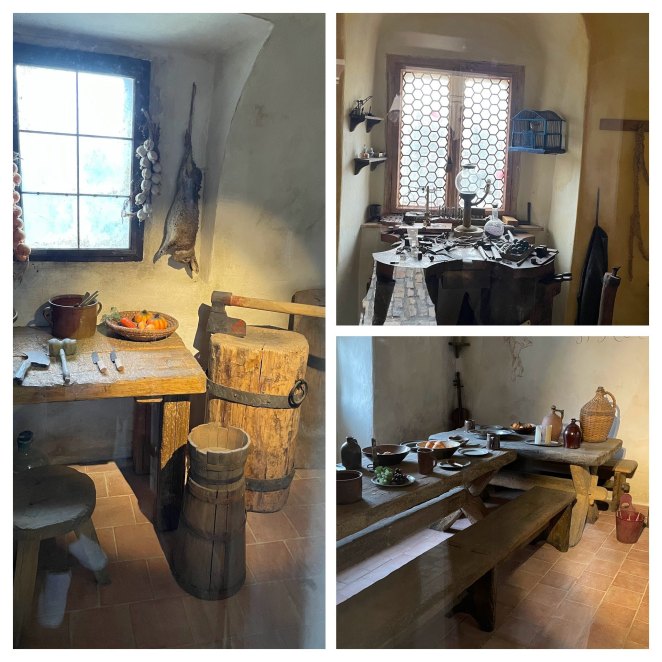
Golden Lane is one of the most famous streets of Prague. Nestled within Prague Castle complex, this 100-meter-long street with its modest dwellings came into existence in 15th century. These houses were once home to castle marksmen, families and goldsmiths. A legend says that this lane was occupied by alchemists who were trying to unravel the secret to artificially make gold from lead, hence the name Golden Lane. The small houses of this lane remain inhabited all the way till World War 2, with the last resident moving out in 1953. Today, some of these historic houses serve as cafés and souvenir shops while others have exhibitions showcasing the life in this lane over its last 500-year history.

St George Basilica
St. Geroge Basilica was first built in 920 by Vratislav I, father of St. Wenceslas (aka King Wenceslas I). It was destroyed in fire of 1142 and was rebuilt in Romanesque style. Over next centuries, new elements were added to the church including Baroque chapel of John Nepomuk. The interior of the basilica is Romanesque and austere. The tombs of members of ruling Premyslid dynasty are situated in the main nave which includes that of Vratislav I.
Petrin hill
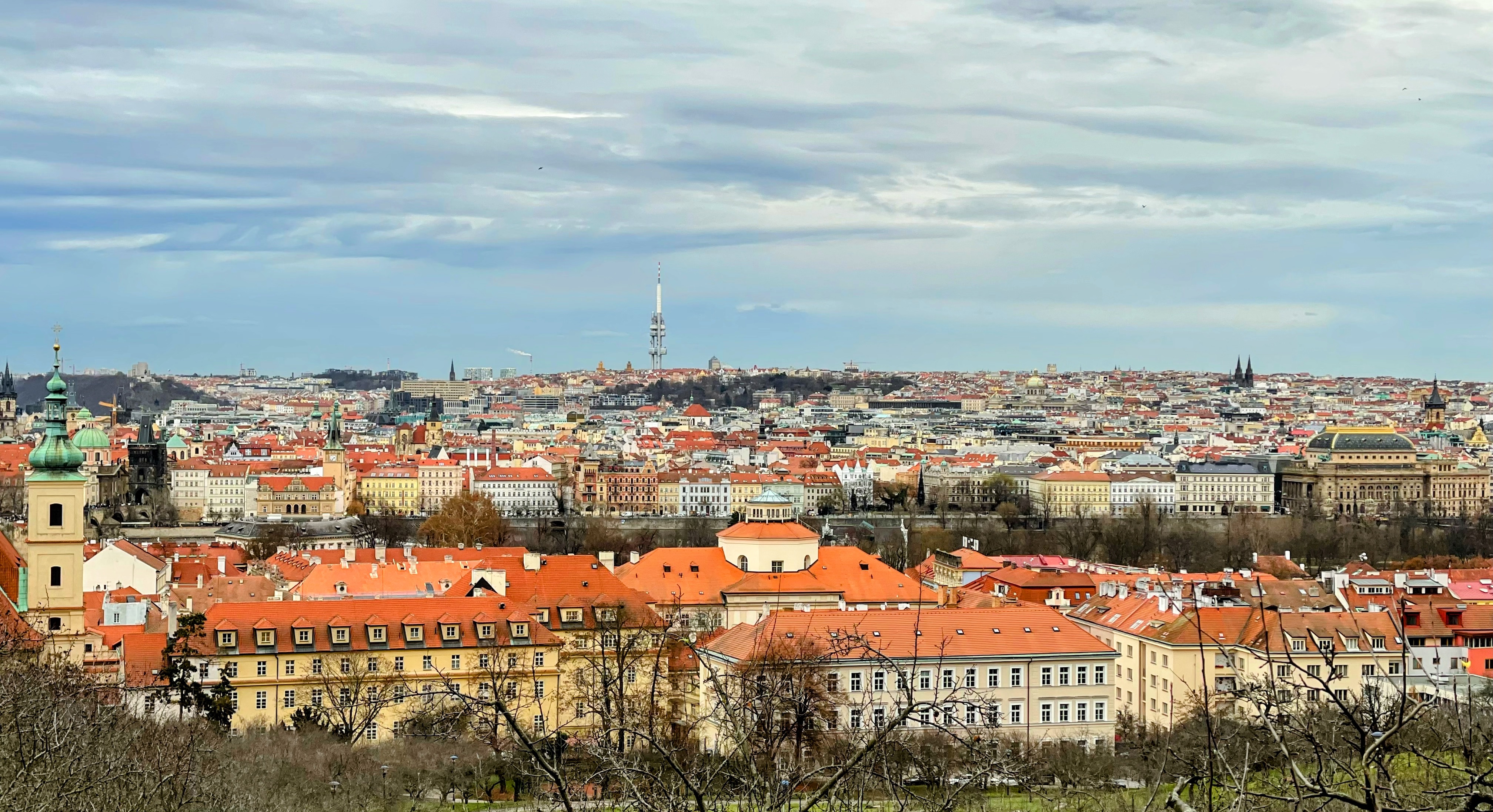
We were done with Prague Castle by noon. We took the bus towards Petrin Hill. At the time, I visited funicular to the Petrin Hill was not working. This funicular was built by an amateur astronomer who liked this serene spot for his research but found it difficult to do regular up and down the hill. Thanks to a staff at Prague Castle, I learnt of an easier way to reach the top of Petrin Hill. I took the bus from Prague Castle to Malovanka and then another bus to Koleje Strahov. The walk up to the hill from here is quite short and easy. This is much better than the steep uphill walk from Ujezd (from where you take the funicular). The walk from Koleje Strahov to the hill takes you through communist style buildings. These huge communist style buildings had hundreds of small apartments. Why? Because the idea was that families spend most of their time outside the apartment, contributing to the community; a large apartment was not needed.
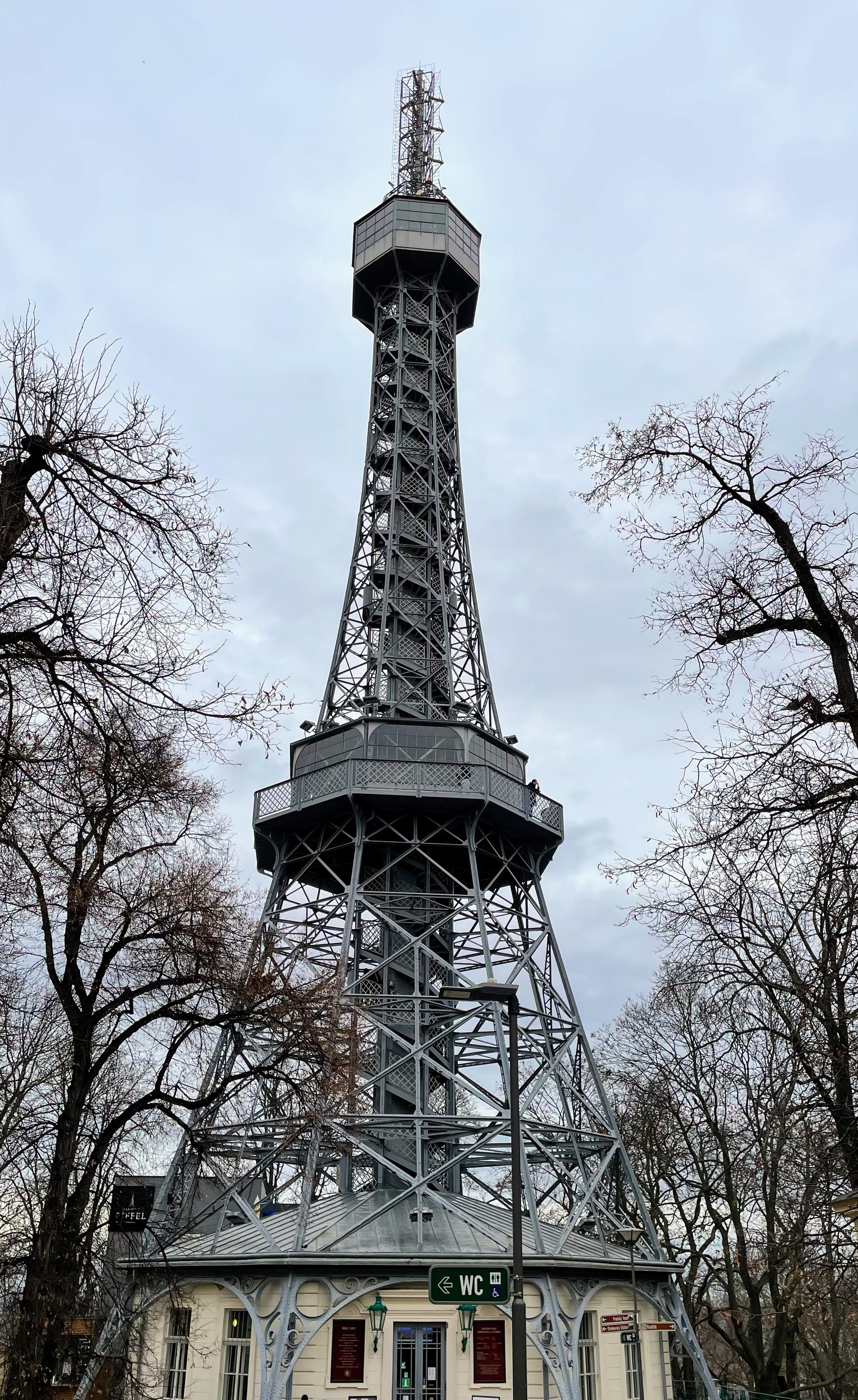
Petrin Hill is a sudden splash of greenery in the middle of town. There are lots of gardens in this area. I must admit that those gardens were not at their best due to winter, but I can envision how beautiful they would look during spring or summer. At the top of the hill is a replica of Eiffel tower. You can go to the top of the tower by paying a fee. Nearby is the world’s largest stadium in the world.
If you are running short of time, Petrin Hill can be easily skipped.

Café Slavia
Café culture of Central Europe is envy of the world. These cafés have been the centerstage of social, political and cultural innovations. Café Slavia played a very important role in Prague’s history. Built right in front of National Theatre in 1884, many famous artists, poets and writers visited Café Slavia. From the large windows of Café Slavia, you enjoy the dance of wind over the otherwise serene waters of Vltava river.
After hours of walking the entire day, we sat back and relaxed with a cup of coffee sided with a decadent cake and apricot crepe, admiring the beautiful surroundings and watching the sun set.


Franz Kafka’s rotating head
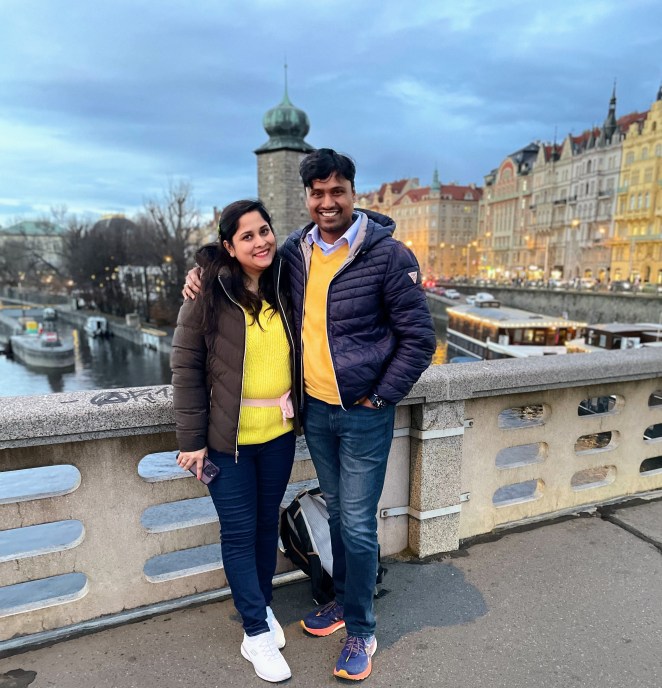
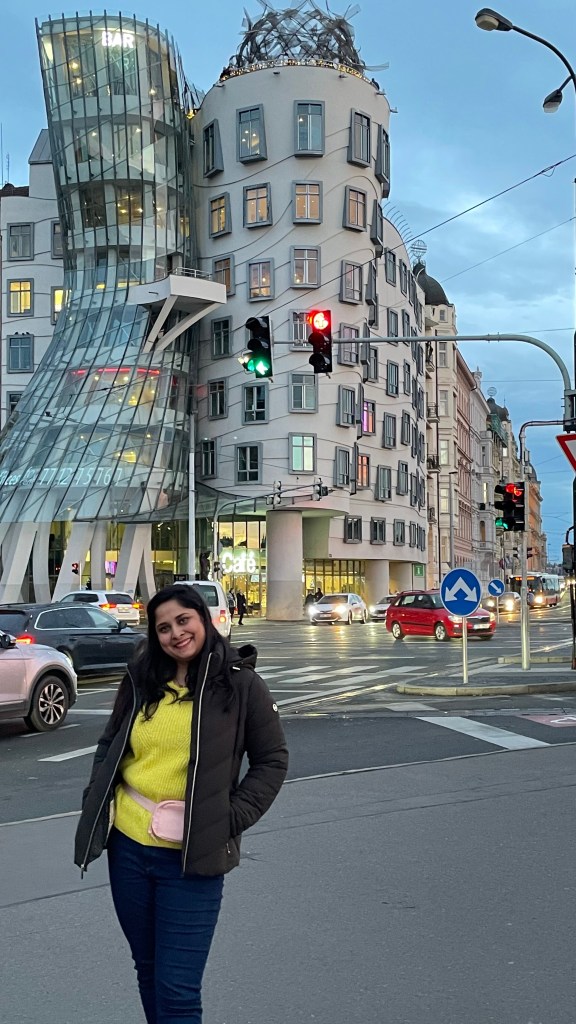
We then headed to see the Dancing House. You can get a great view of Petrin Hill across the Vltava River from the bridge just across the street. We just took a few pictures and headed in the direction of Franz Kafka’s rotating head. This modern sculpture rotates for 15 minutes at the top of the hour. So, we had to wait some time before we could see it in action.

Day 4, Dec 20th 2024
Charles bridge
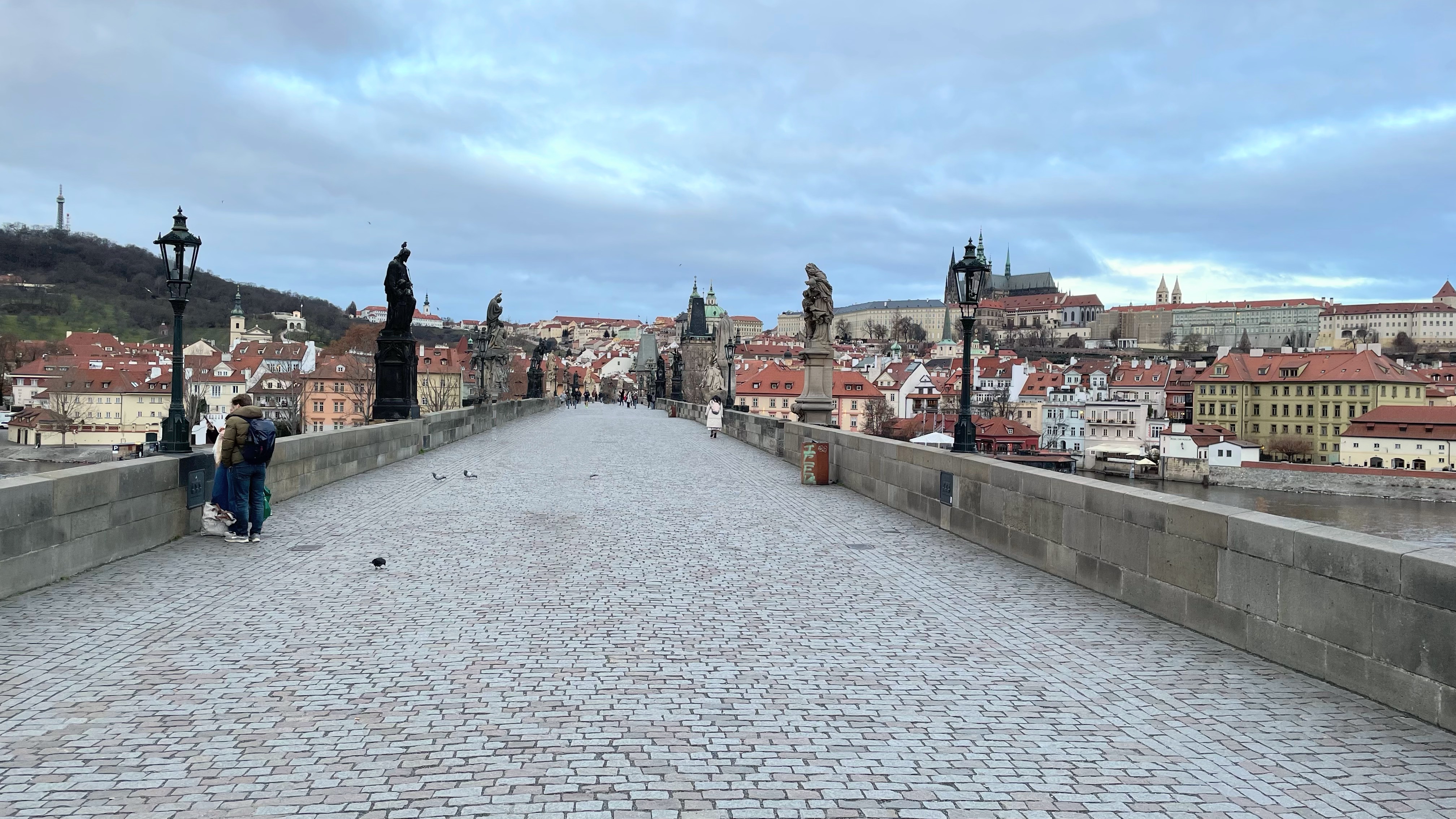
As the city of Prague slowly woke up—its streets rubbing the sleep from their eyes and stretching with a yawn—the first rays of sunlight filtered through the buildings, casting a golden glow. We arrived at Charles Bridge just in time. This iconic landmark grows crowded with tourists as the day goes on, so arriving early is the best way to enjoy some peaceful moments and truly take in the beauty of the bridge—and of Prague itself.
Charles Bridge was commissioned to be built by King Charles IV in 1357 to replace an older bridge that had been damaged, as parts of it washed away in a flood. The bridge connects Prague Castle and the city’s Old Town, two very important Prague landmarks! Charles IV was a firm believer in numerology. So, he got the construction work started at 5:31 AM on 9th July 1357 which is a palindrome (1357, 9/7, 5:31). At the time of its completion in 1402 and many centuries later it was referred to as Stone Bridge or Prague Bridge. It was only starting in 1870 that it was referred to as Charles Bridge. At 516 meters in length and 10 meters in width, this magnificent bridge was the only means for crossing Vltava river and remained an integral trade route connecting east and west Europe. It was instrumental in bringing a lot of wealth to the city of Prague. There are 3 gothic towers which give uninterrupted view of town’s rooftop – 1 tower on old town side and the other 2 on the lesser quarter side.
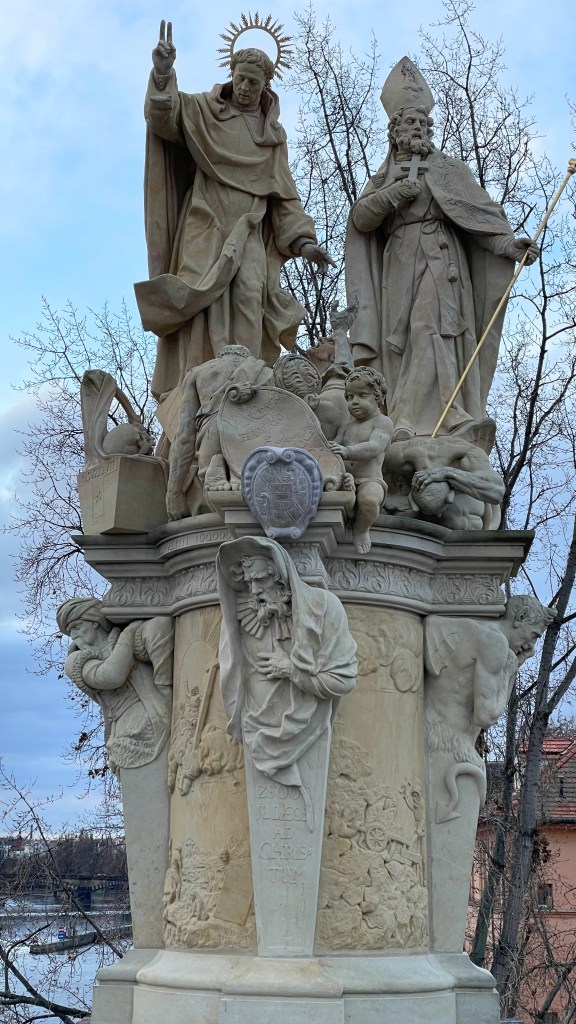
The thirty famous intricate baroque style statues adorning the balustrade of the bridge were erected around 1700s, but most of them didn’t withstand the tide of time and have been replaced by their replicas.


Astronomical Clock (Orloj)
We had seen Astronomical Clock Tower during our walking tour in Day 2, but it was a mere glimpse. We wanted to explore it more deeply.
Important tip – Visit Astronomical Clock Tower at the time of its opening. During the first hour after its opening (9-10 AM), there is an early bird discount and the admission price of 300 CZK to the tower is reduced by 50% to 150 CZK. Plus, you can also book a guided tour of the Old Town Hall (of which Astronomical Clock is a part of), by paying a surcharge of 150 CZK. This guided tour can only be booked on the spot and gets filled very soon. More details here – Old Town Hall with Astronomical Clock | Prague City Tourism.
After spending about an hour at Charles bridge, we reached the ticket counter at Old Town Hall at 9 AM to get tickets for climbing up the Astronomical Clock Tower and the guided tour of Old Town Hall. We walked up the tower. I think there is no need to pay extra to take the elevator to reach the top of the tower. Walking up is quite a breeze as there is an accessible ramp to walk up. Only towards the end is there a narrow 10-15 stairs.
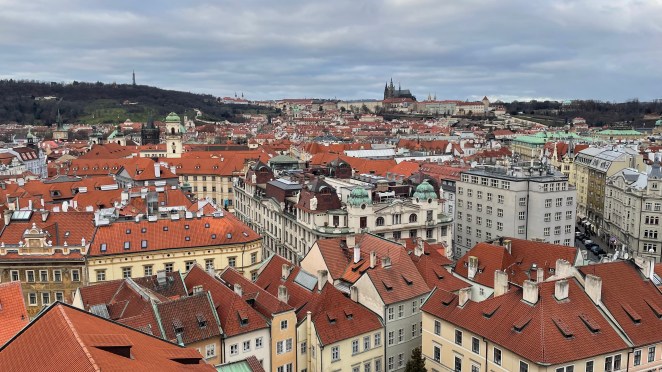
From the top of the Astronomical Clock Tower, you get the stunning view of red-tiled rooftops stretching across the cityscape. The Vltava River winds gracefully through the heart of the city, while the spires of historic churches and Prague Castles adorn the skyline. No wonder, Prague is called “City of hundred spires”.
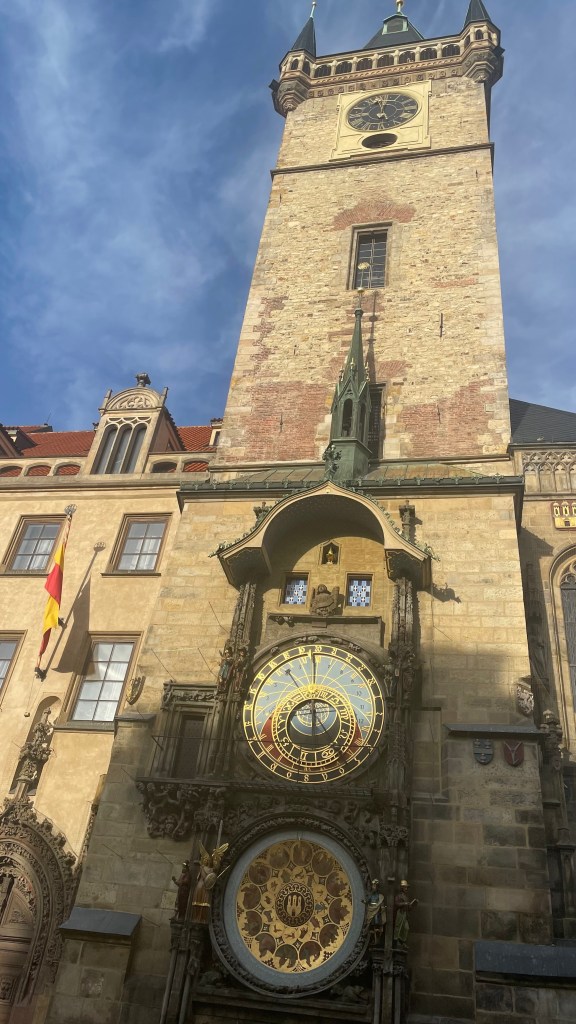
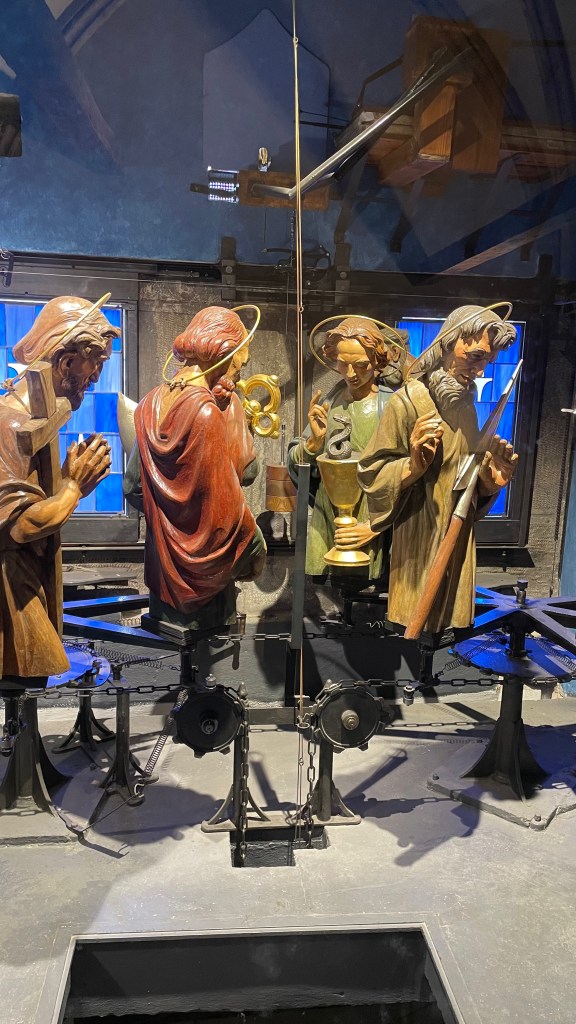
Astronomical Clock was built in 1410 by Miklaus of Kadan. Later towards the end of 15th century, the calendar dial was added, and the façade was decorated with gothic sculptures. It is divided into a calendar with zodiac and a clock. The clock shows the position of sun and moon. It is placed in the southern tower of Old Town Hall. Every hour from 8 AM to 11 PM, 12 apostles appear in two windows below the roof. In the left window, viewed from outside, the first to appear is St. Peter with a key, then St. Matthew with an axe, St. John with a chalice, St. Andrew with an X-shaped cross, St. Philip with a cross. St. James with a washboard, and in the right window, it is St. Paul with a book, St. Thomas with a spear, St. Simon with a saw, St. Thaddeus with boards, St. Bartholomew with leather, St. Barnabas with a scroll.
At the stroke of the hour, skeleton pulls the rope, and the 12 apostles begin to walk in the windows with ringing. In addition to the skeleton, the other movable figures are allegories of lust, misery and vanity. After all the 12 apostles have passed the windows, they close and the golden rooster at the top crows followed by the chiming of clock. You can learn more about the clock here – Astronomical Clock | Prague City Tourism.
The original apostles were destroyed, and other parts of the astronomical clock tower were severely damaged in May 1945 due to Nazi air raids. What you see today are replicas created during restoration project undertaken after the war.



Old Town Hall
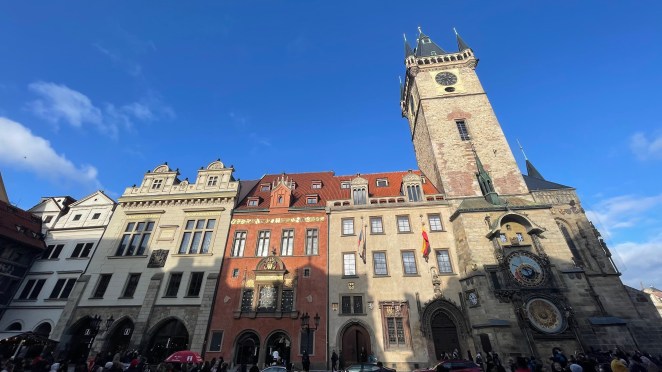
Old Town Hall was established as the administrative center in 1338. The town hall acquired its current look when 5 medieval burgher houses were combined, one of which houses the famous astronomical clock. During the 2nd World War, Czech Republic was taken over as protectorate of Germany, so the city of Prague didn’t see the widescale destruction that rest of the Europe saw. However, towards the end of the occupation, the town hall, including the astronomical clock were badly damaged. However, many parts of the original construction still exist, especially the underground Romanesque cellars.
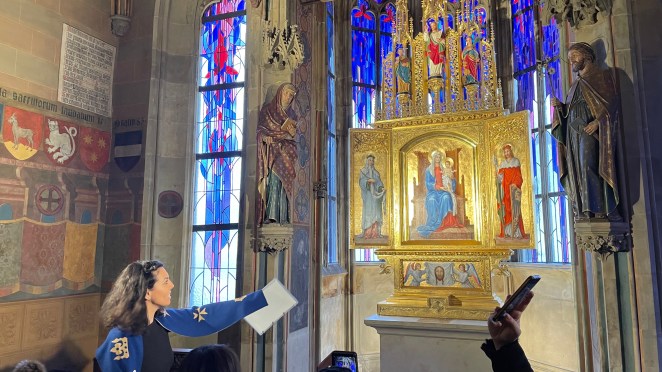
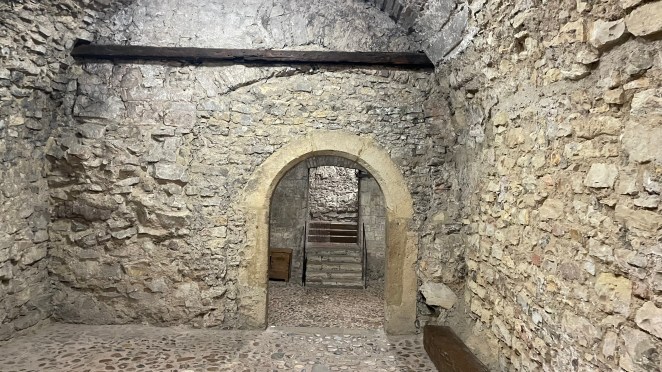
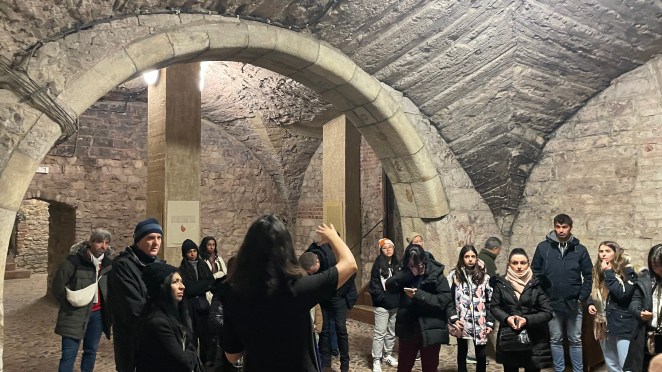
During the guided tour, we started with a chapel built on the first floor in the body of the tower. The altar of the chapel has portraits of Ludmila and St. Wenceslas on either side of Virgin Mary. The scarf around Ludmila depicts that she was murdered. Adjacent to this chapel is the chamber that houses the famous 12 apostles of the astronomical clock. It was exhilarating to see the inner details of the astronomical clock and its apostles up close. The tour guide took us through different buildings of the town hall and explained their historical and current purposes. The most exciting part for me was when she took us to the underground cellars.
These underground cellars were the original level of the city of Prague, the level of Vltava river. But due to frequent flooding, the city was elevated by at least 2 meters in 12th century. As a result, these cellar/houses became ‘underground’.
Why did people of Prague prefer beer over water?
These frequent floods in Vltava made water unfit for drinking. As a result, people of Prague skewed towards drinking beer. This is not unique to the city of Prague. Beer has been brewed in human history for thousands of years. In ancient Egypt, beer was seen as a life sustaining beverage, given to laborers working on pyramids. It had health benefits and calorific value. The ‘long boils’ during its preparation killed pretty much any pathogen while the remaining ones couldn’t survive the fermentation process. Moreover, beer was an important source of calories and nutrients, especially in societies where food might be scarce at certain times of the year. But gradually, its importance declined with Greeks and Romans who gave more importance to wines. They considered beer as ‘barbarian’, not aligned with refined lifestyle they promoted.
St. Nicholas Church
Dedicated to St. Nicholas, this baroque church was built in 1732 and 1737. Entry to the church is free. The interior here was in stark contrast with that I saw at St. Vitus Cathedral which was of gothic style. Ceilings are painted with frescos with a huge chandelier looming in the center. The walls are adorned with sculptures of mythical figures and have delicate golden embroidery on the walls which gives a very rich feel. Shalini and I sat in the church for some time reveling at the master craft and absorbing the beauty.
St. Nicholas –> Sinterklaas –> Santa Claus
St. Nicholas of Myra (in present day Turkey) was a Christian bishop who lived between 270-343 AD in Roman empire. He was popular for giving secret gifts to people, especially children giving rise to the folklore of Santa Claus and Sinterklaas (in dutch Sint Nicolaas)
Powder Gate Tower
This is where we started our walking tour on 18th. Darkened with age, the foundations of this tower were laid in the 15th century, and it is one of the few medieval gates that remain in Prague today. Originally, there were 13 gates and a moat safeguarding the old city. In the 18th century the tower was used to store gunpowder, hence the name. This gate was used for coronation procession of Czech kings which entered though through this gate and went to Prague Castle.
Jewish quarter (Josefov)
During the 13th century, Jewish people living in Prague were forced to vacate their homes and live in an area between Old Town and the Vltava River. The houses were smaller, and families were forced to live in apartment-style buildings. Over time, this area became a vibrant center of Jewish life with synagogues, schools and marketplaces coming up. In 1782, Emperor Joseph II (son of Maria Teresa) emancipated Jews by providing them the religious freedom and equal rights.
Later this area was renovated in 1900s.
The highlight for me was the Jewish cemetery. Jews were not granted additional space for burying their loved ones. So, a new layer of soil was heaped on the available area of the cemetery and then new dead bodies were buried. It is believed that as many as 12000 bodies are buries at this old Jewish cemetery with as many as 12 layers of bodies. Due to this layering, the cemetery is at much greater height than the street level.
Wenceslas square
This square is named after the venerated patron saint of Bohemia, St. Wenceslas, and has his equestrian statue. More than a square, it is best described as a boulevard which is almost a kilometer long with lots of shops on both the sides. The street slopes upward leading upto the grand Czech National Museum.


Café Louvre
Another legendary café in Prague. This has been serving since 1902. The café is particularly associated with famous figures such as Franz Kafka and Albert Einstein, who were regular patrons. We ordered chicken breast and grilled goat cheese. However, it was the mini dessert platter of Choux, Pavlova and Sacher which stole the show for me.

Black light theatre
In the night that day, we tried something unique. We watched a show at black light theatre. The entire theatre is in pitch darkness throughout the performance. The actors are dressed in all black costumes which in combination with surrounding darkness makes them invisible to the audience. The story is told by moving props painted with fluorescent dye which makes the props visible to the audience. Thanks to this, a dancer wearing fluorescent clothes may appear to fly or levitate. In reality, she is held by another man dressed completely in black; an actor who the audience cannot see.
I liked the show for its sheer ingenuity and technique; however I think the story told could have been better.
Day 5, Dec 21st 2024
Illusion art museum
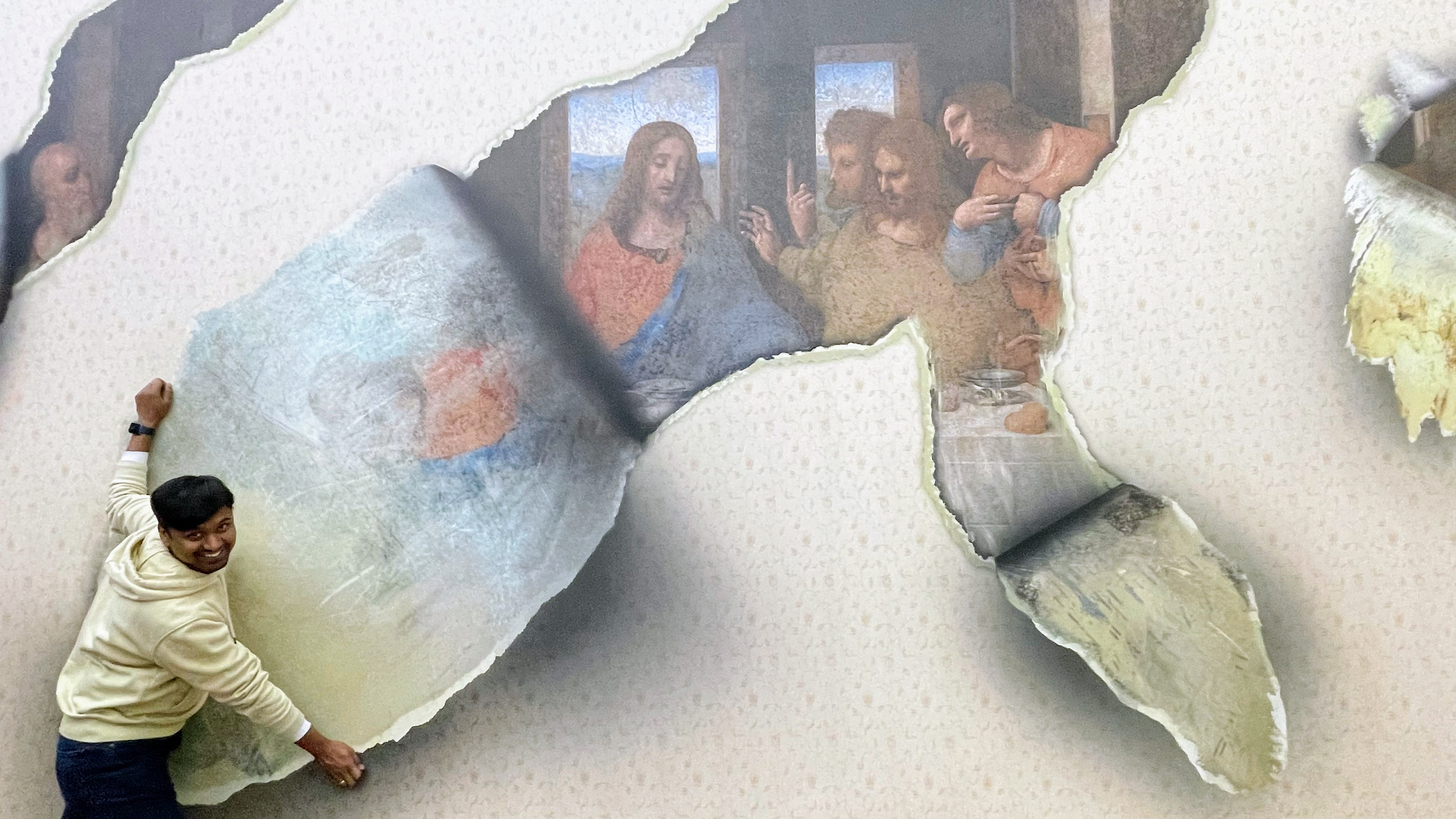
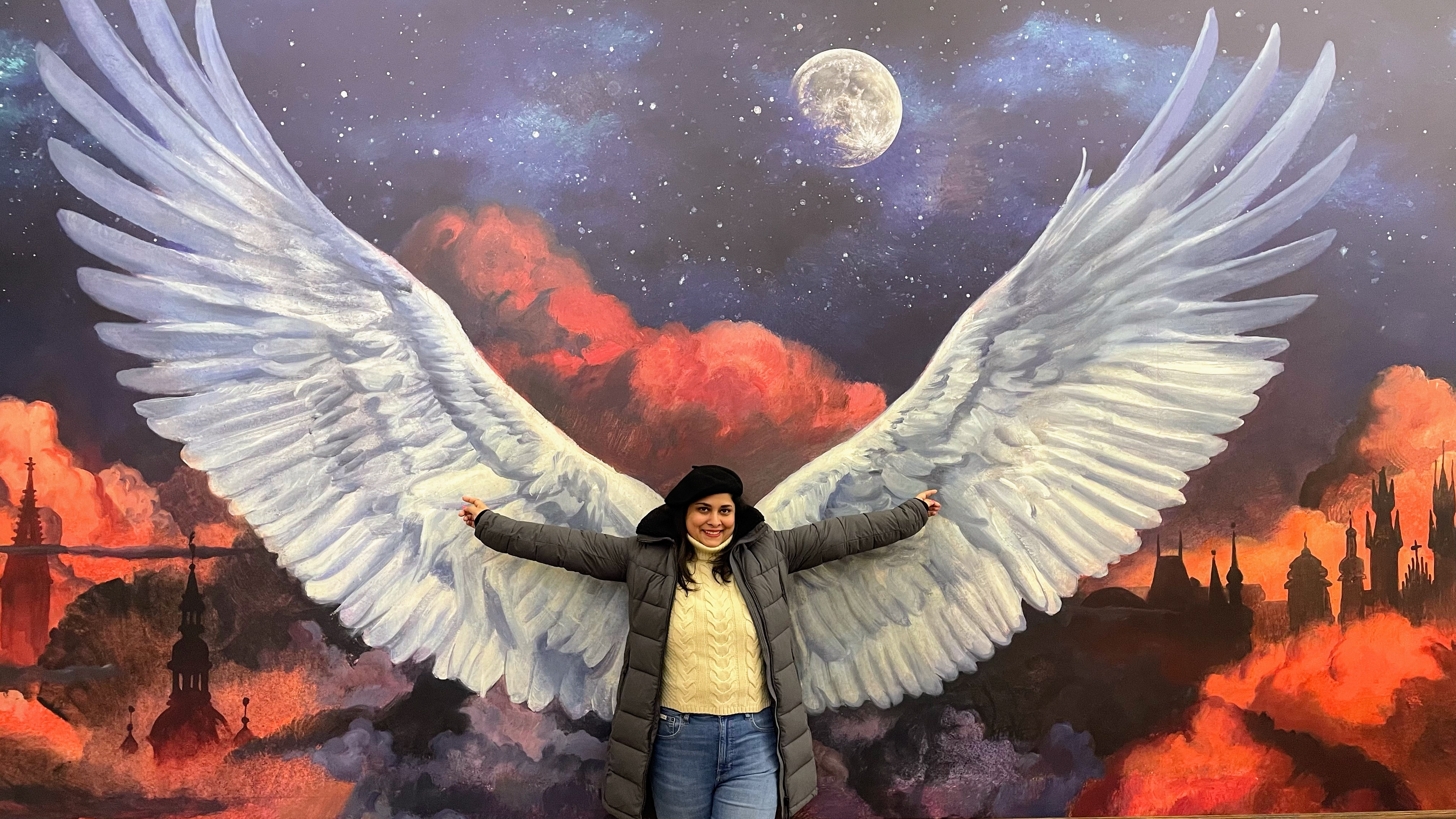
This was a relatively relaxed day. We went to Illusion art museum. It is a combination of illusion, art and history. Artistic Illusion techniques are used to commemorate famous historical figures and how they applied their skills. Some works are directly related to important figure and events from Czech history.


Havelska Koruna
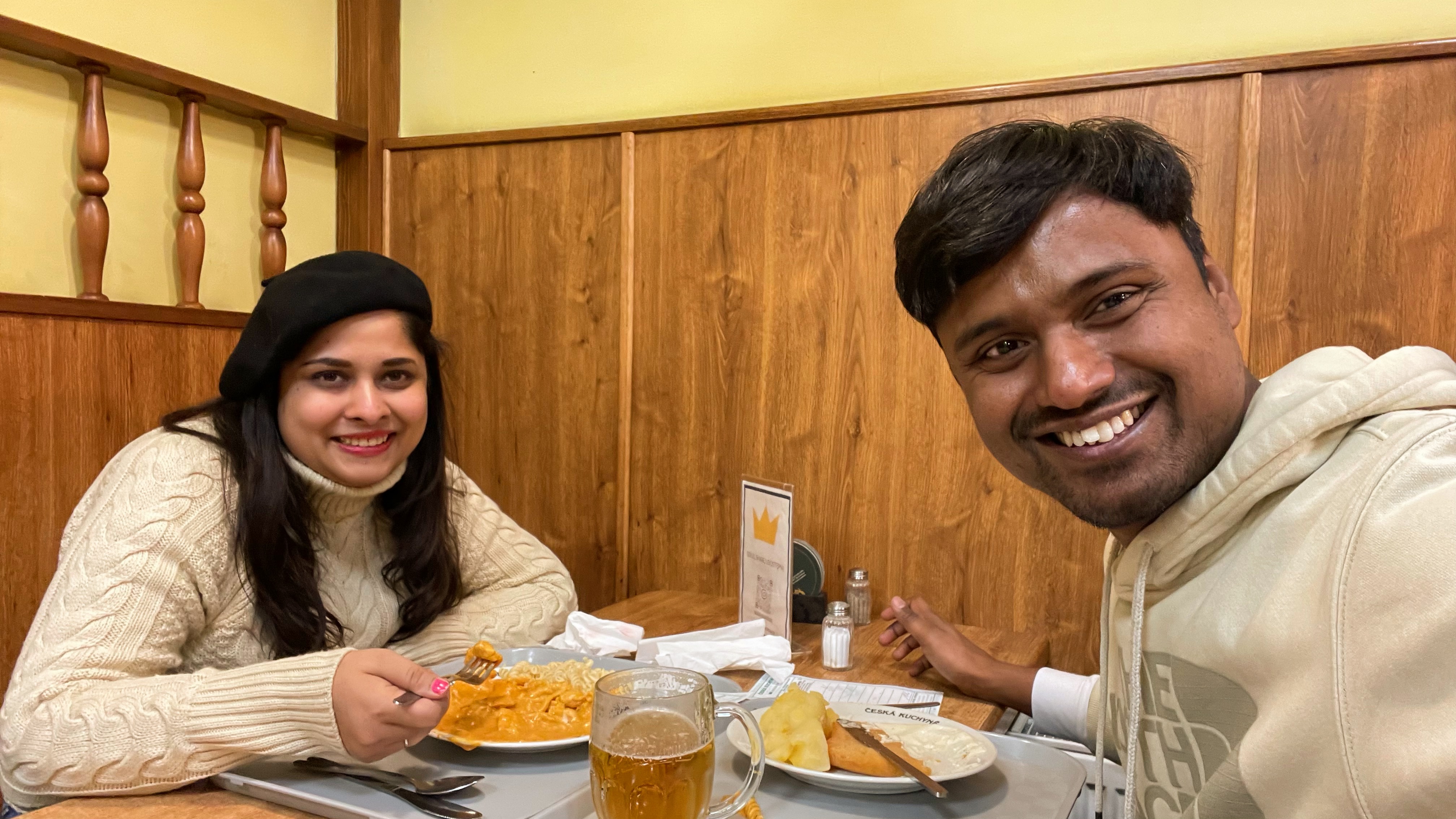
We went to legendary authentic Czech restaurant Havelska Koruna. Shalini had paprika chicken with pasta and I had fried gouda cheese.
We wrapped up the day early as we had to leave for Vienna the next day, so we had to do some packing. From my college days, I dreamt of visiting Prague. And I must say, it didn’t disappoint me at all.
See you in Vienna …

 Abhijeet Kumar Sinha