Day 1, June 23rd
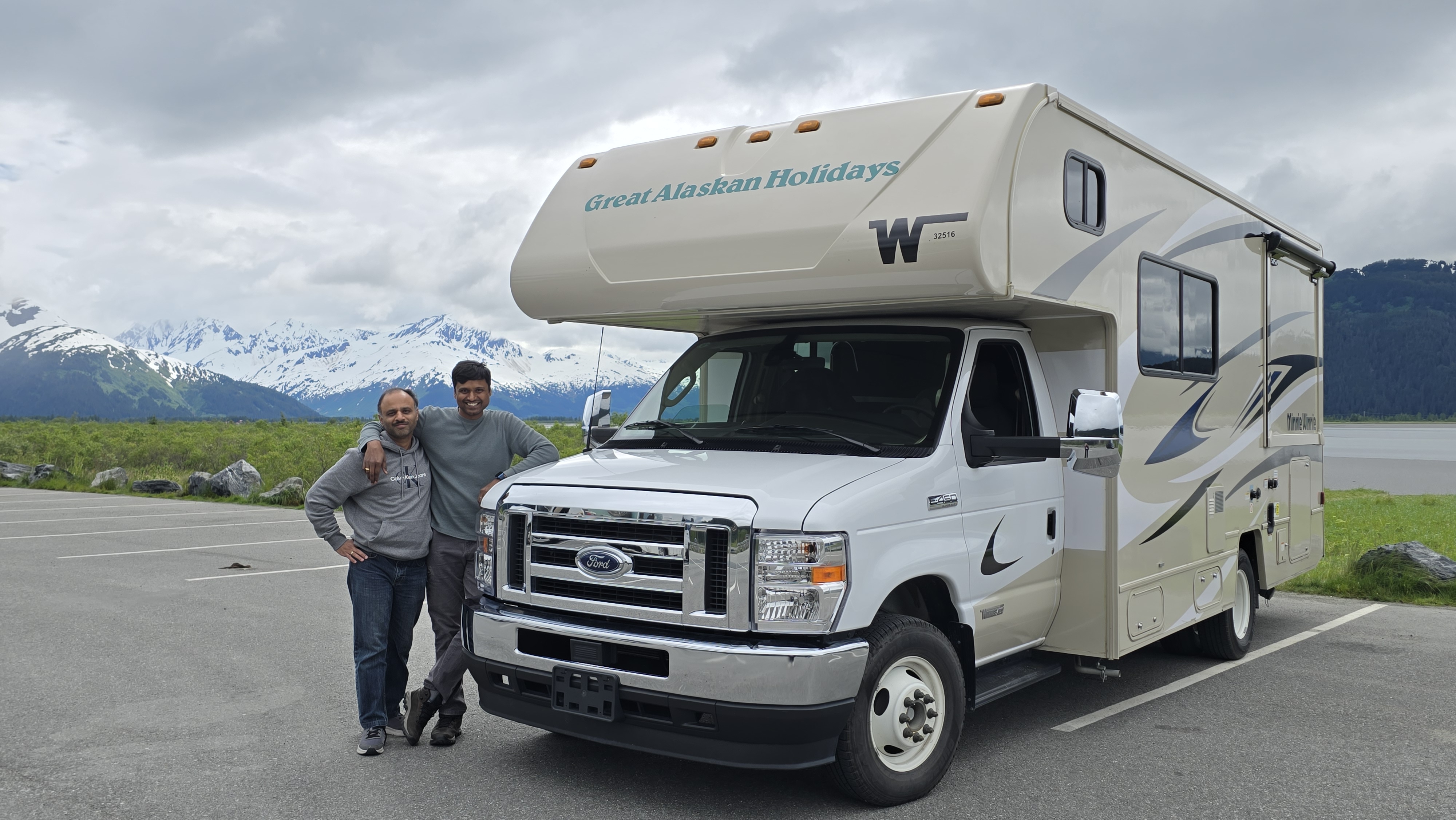
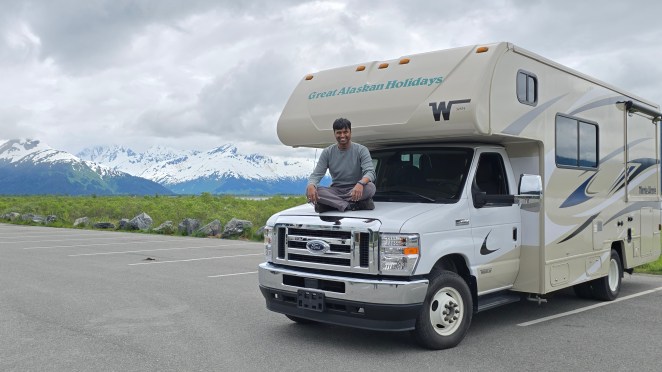
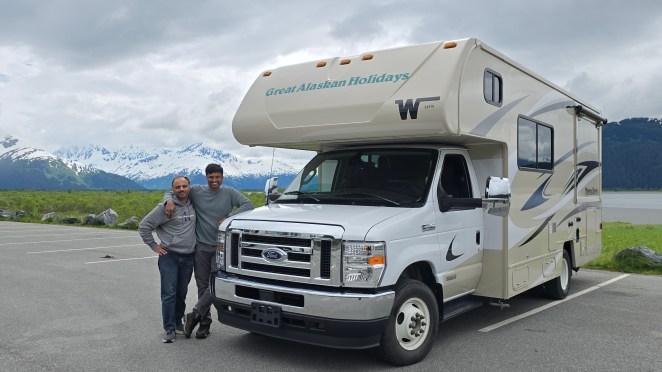
We landed in Anchorage around 9 AM, groggy but filled with the kind of excitement that only Alaska can spark. By 10:15, we had picked up our RV—our moving home for the next 12 days. The inspection kept us busy until 11:30. I was a bit hesitant about driving such a big vehicle, so Raj took the steering to start the trip. Watching him handle the RV so confidently was reassuring, even though the size of the vehicle still felt surreal.
Before hitting the open road, we made a stop at Costco Anchorage, and this visit surprised us more than anything else that morning. The prices were almost identical to Seattle, and the aisles were stocked with familiar items—chicken tikka masala, sona masoori rice, Indian snacks, everything you’d expect back home. A useful tip for any traveler: don’t overpack food. Anchorage’s Costco has you covered. Lunch was a quick classic—Costco pizza—before we swung by Walmart to pick up disposables and toiletries.
By 2 PM, the real journey began. We started driving toward Whittier, following the legendary Seward Highway, one of the most scenic roads in America.


Beluga Point — The First Taste of Alaska’s Grandeur
Not too far from Anchorage lies Beluga Point, a rocky viewpoint overlooking Turnagain Arm. This spot is named after the beluga whales that often swim close to shore during salmon runs. The ocean here isn’t gentle blue—it’s a swirling, steel-gray expanse shaped by some of the strongest tides in North America. Standing there, with wind brushing against our faces, we felt the first tug of Alaska’s rugged beauty. We didn’t see any Beluga whales, but it was certainly a good pit stop.
Turnagain Arm — Nature’s Monument of Power
Turnagain Arm is a narrow waterway that extends in an east–west direction for about 40–45 miles . It sits at the edge of the North American Plate, directly facing the Pacific Plate. This region lies along the Alaska-Aleutian subduction zone, one of the most active tectonic boundaries on the planet. Here, the Pacific Plate is slowly sliding beneath the North American Plate, creating intense pressure, frequent earthquakes, and dramatic uplift and subsidence of the land. The 1964 earthquake—the second largest ever recorded with magnitude of 9.2—dropped parts of this region by nearly 8 feet.
Turnagain Arm has some of the fastest and highest tides in North America, sometimes rising or falling more than 30 feet. These tides, combined with glacial silt from nearby glaciers (like Portage and Spencer), create shifting mudflats. These mudflats are extremely fine and looks like wet cement. It traps air, creating suction that can hold a person’s foot like quicksand.
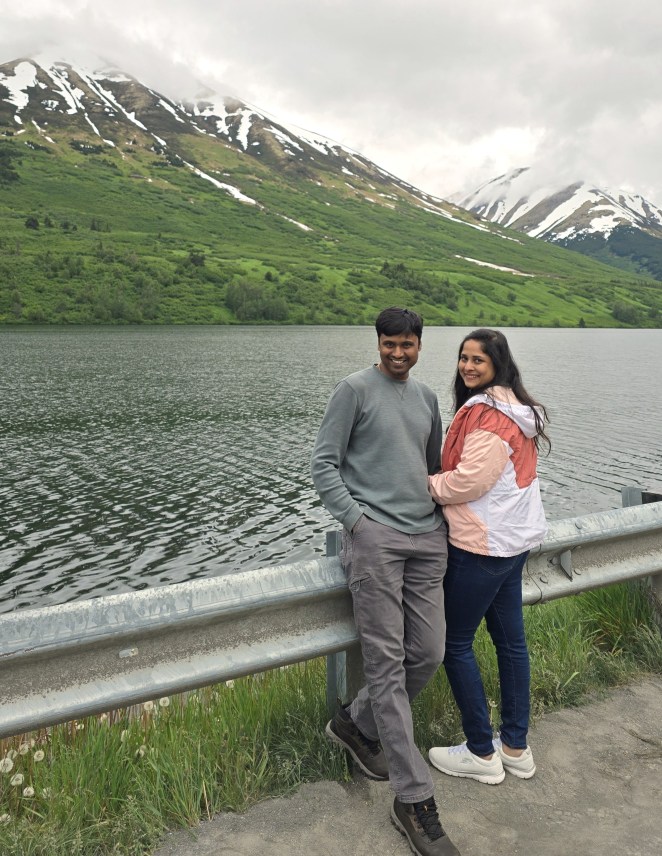
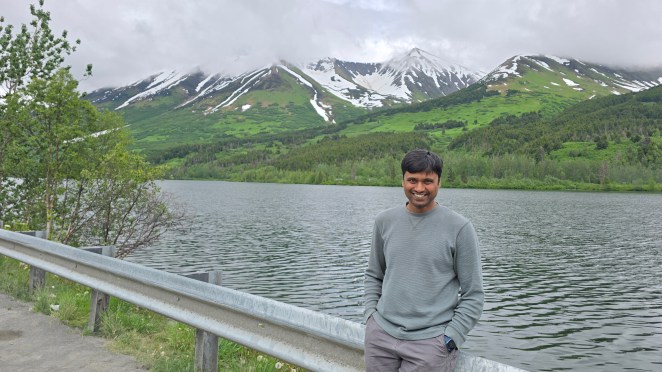
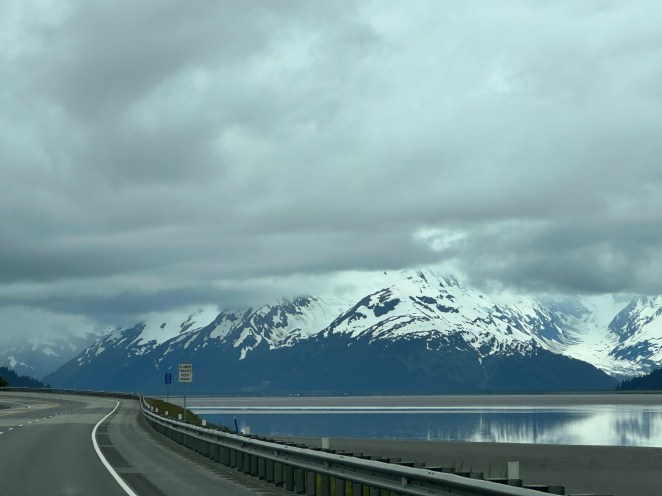
Driving deeper into Turnagain Arm, the landscape began transforming dramatically. Massive mountains rose almost straight out of the water, their slopes covered in green moss that looked like soft velvet. Higher up, snowmelt trickled down in white streaks, creating a breathtaking contrast of emerald and white. This road is more than beautiful—it is geologically fascinating.
The land, sea, and mountains here are constantly reshaping each other. And yet, as you drive along the edge of the Arm, the world feels incredibly peaceful. This was the moment the trip began to feel real. Every mile brought us closer to snow-clad peaks, and Alaska slowly revealed the scale that pictures can never do justice to.
Portage Glacier — Where Ice Still Rules
Around 4 PM, we reached Portage Glacier which is a classic valley glacier, carved between the rugged peaks of the Chugach Mountains. These mountains themselves were created by the collision of the Pacific and North American tectonic plates, which uplifted, folded, and fractured the landscape into the dramatic, steep-walled valleys we see today. As the glacier advanced and retreated over millennia, it sculpted a wide U-shaped valley, ground massive amounts of bedrock into fine glacial silt, and filled the region’s rivers and lakes with icy blue meltwater. Even though it has retreated significantly in recent decades, Portage glacier deeply significant for Alaska as it feeds Portage Lake, influences local ecosystems, shapes the region’s tourism economy
Walking in the cold air and seeing such raw natural power reminded us of how tiny we truly are.


The Anton Anderson Memorial Tunnel — A Journey Through the Mountains
To reach Whittier, we passed through the Anton Anderson Memorial Tunnel, an architectural marvel of Alaska. This 2.5-mile tunnel is the longest highway tunnel in North America and one of the few shared by both cars and trains. Driving inside was thrilling and unsettling. The tunnel is narrow, barely enough for the RV, and every vibration echoes off the chamber walls. Raj had to grip the steering tight to keep from drifting sideways. Only one direction is allowed at a time, so cars wait in groups before being let through. To save time and avoid long wait you should refer to the direction and time here – Whittier Tunnel, Transportation & Public Facilities, State of Alaska.
Whittier — A Town Hidden Behind Mountains
As soon as we exited the tunnel, everything changed. Whittier greeted us with rain, thick clouds, and a heavy gray sky. The dramatic shift in weather is classic rain-shadow effect: the Chugach Mountains trap moisture-laden air from warm open Gulf of Alaska, making it much wetter than the Anchorage side. There is Cook inlet on the other side of Chugach mountains but this water body is much narrower and is fed by cold glacial water. That’s why Anchorage is on rain shadow side. It’s the same phenomenon we see in Washington—the Cascades make the west wet and the east dry.
The main highlight today in Whittier was the Begich Towers, often called the Hodge Building. This massive, bunker-like structure is one of Alaska’s most unusual architectural relics. Built during the Cold War for the U.S. Army, it housed soldiers and workers in an all-in-one complex. Today, nearly the entire town lives inside this single building—homes, stores, offices, even municipal services. It’s a fascinating blend of practicality, isolation, and history.

Whittier, drenched in gloom today, didn’t charm us much. But we would return at the end of our trip—and that’s when we saw its true beauty. More on that later.

Back On the Seward Highway — The Road to Homer
After losing some time at the tunnel crossings, we rejoined Highway 1 and continued our push toward Homer, with the landscape taking on a cinematic quality. The mountains became even more dramatic—jagged peaks, flowing ridges, snow patches clinging to the top, and clouds resting gently on the summits.
The vegetation shifted constantly. At higher elevations, we saw tundra vegetation, low and wind-resistant. Down at the base, the forests thickened with tall but thin-trunked trees—a trait shaped by short growing seasons and limited sunlight. Purple lupine flowers lined the road, their color glowing against the deep greens and blues of the landscape.
At times, it reminded me of Arrowhead Mountain in Iceland, and at others, the closeness of the mountains felt like Grand Teton National Park. But everything here was bigger, wilder. You could see traces of old avalanches carved into the slopes, silent reminders of nature’s power.
About 20 miles before Homer, a moose appeared on the roadside—quiet, majestic, and completely unfazed by us. Moments like this are what make Alaska feel alive.
Kachemak Bay — Midnight Light and First Night in Homer
We finally reached Kachemak Bay around 10 PM, and even at that hour, the sky was glowing with soft daylight. Alaska’s summer light does something to the soul—it blurs the boundaries of time, making the world feel endless. The bay itself is a geological masterpiece, carved by ancient glaciers and surrounded by snow-capped mountains and deep blue water. Its biodiversity, from sea otters to puffins, makes it one of the richest marine environments in the region.
By 11:30 PM, we rolled into our full-hookup campsite, Ocean Shores RV Park in Homer. Exhausted, relieved, and overwhelmed by the beauty we had witnessed, we settled in for the night—our first night of many adventures ahead.
Day 1 set the tone beautifully: Alaska is vast, unpredictable, and heartbreakingly beautiful. And we had only scratched the surface.

 Abhijeet Kumar Sinha