Day 3, June 25th
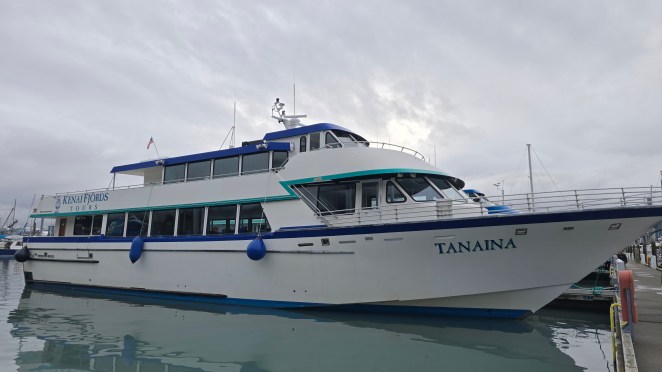
Today was our long-awaited Captain’s Choice National Park Tour with Kenai Fjords Cruises—a nearly seven-hour wildlife adventure deep into Resurrection Bay and the rugged, glacier-carved wilderness of Kenai Fjords National Park.
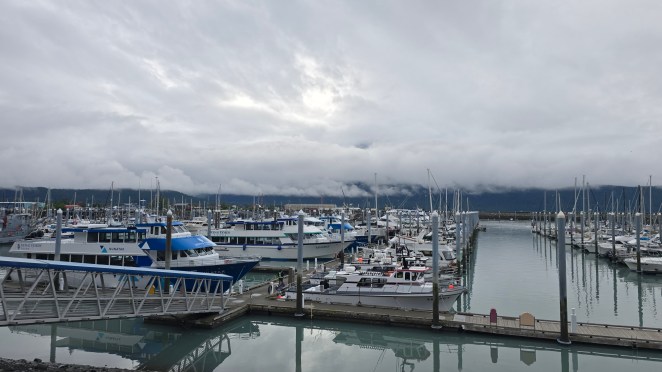
After a quick breakfast, we drove toward the cruise terminal. A good tip: arrive at least 30 minutes early. There is no RV parking near the office. They have a dedicated RV parking, but it is farther away with shuttle to move customers between the lots and the cruise dock. Even at 8:45 AM, the place was buzzing with energy—tourists layering up, photographers prepping cameras, and the harbor gulls shrieking overhead as if they, too, were ready for the show.
Resurrection Bay – the cold hits first, then the wonder
The moment our boat pushed away from the harbor sharp at 9AM, reality struck—it was freezing. Inside seating filled up instantly, forcing us onto the open deck. One by one, every layer we had—jackets, wool caps, gloves, scarves—came out of the backpacks. Alaska wastes no time reminding you that nature runs the schedule here.
But the discomfort faded the moment we spotted our first wildlife. On a tall navigation tower stood a bald eagle, regal and motionless, surveying Resurrection Bay like a king watching over its icy kingdom. The captain steered deeper into the bay, where rugged cliffs rose straight out of the ocean and low clouds hugged the fjords like a soft grey blanket.
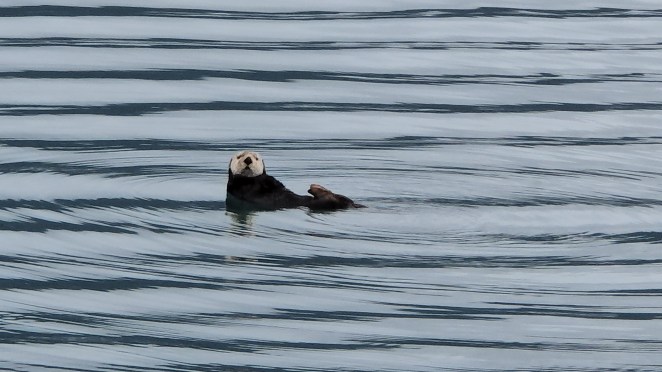
Then came one of my favorite sights: a sea otter floating on its back, nibbling on a crab. Otters have over a million hairs per square inch—more than any other animal—keeping them warm and dry. Their claws stay lifted above water as they eat, like tiny hands holding a delicate meal.
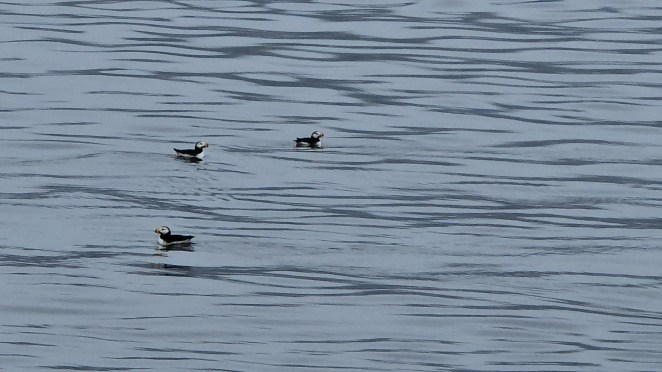
A little farther were puffins, tiny black-and-white birds with orange beaks, flapping their wings rapidly just to stay in the air. They looked like anxious, adorable footballs trying their best to fly.
As we headed deeper into the Resurrection Bay, towering rocky walls appeared into the landscape – Fjords. Carved thousands of years ago by powerful glaciers, these fjords stretched inward like deep, frozen fingers of the ocean. Mist clung to mountain tops, drifting between peaks like spirits moving through the wild.
The captain took us around several islands, each rising unexpectedly from the water—some bare, others covered with spruce trees gripping the steep slopes.



Aialik Bay – Dolphins, whales, orcas
Leaving Resurrection Bay, we crossed into the more remote Aialik Bay, and suddenly, the ocean exploded with life. Out of nowhere, gray-white dolphins—dozens of them—raced toward our boat. They surfed the waves created by the bow, diving in and out rhythmically, as if inviting us into their joy. Every single passenger rushed outside despite the cold. For a few minutes, nothing existed except the sound of water, the laughter on deck, and dolphins leading the way.
Then came the giants.
Humpback whales surfaced near the shoreline, their massive bodies rolling gracefully. Because the water wasn’t deep enough, they didn’t perform the dramatic tail dive humpbacks are famous for—but seeing them feed so close to the rugged coastline was breathtaking.
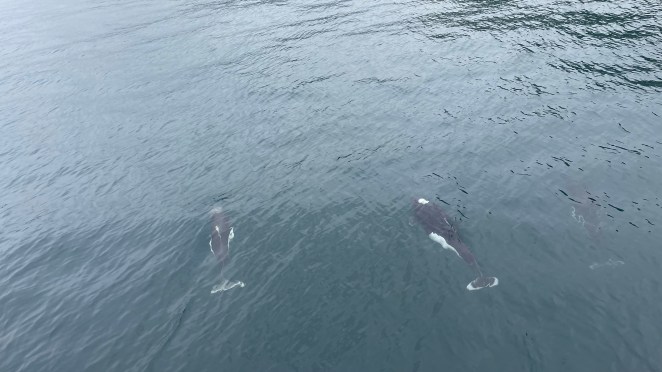
And then, cutting through the water like black-and-white arrows—killer whales. Tall dorsal fins sliced the surface with quiet power. Orcas move differently than humpbacks; they are deliberate, coordinated, like a family patrolling their territory.

Holgate Glacier – A Tidewater Giant
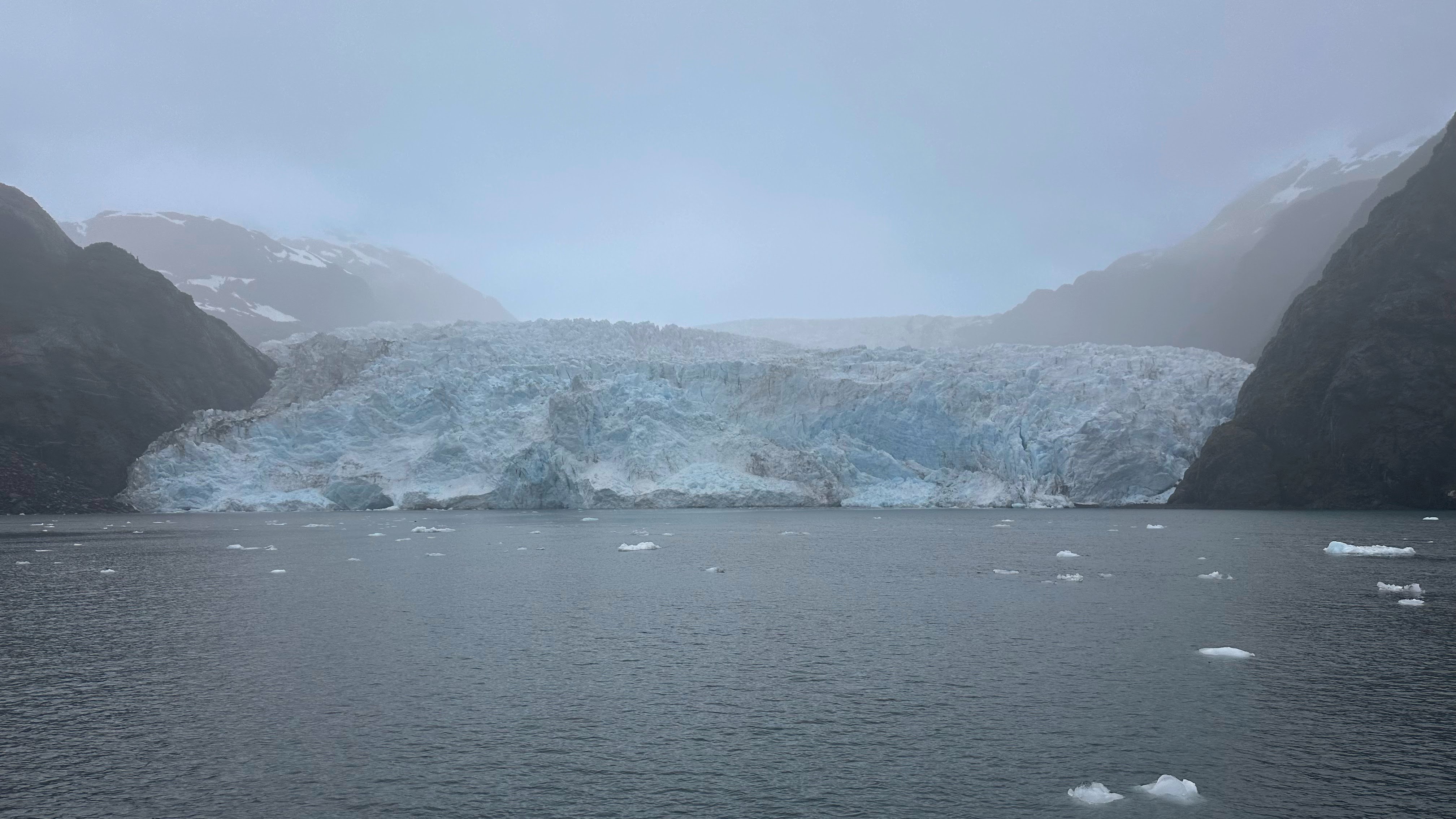
Around early afternoon, the boat began entering the Holgate Arm, the final stretch leading to the astounding Holgate Glacier. Holgate is a tidewater glacier, meaning it flows directly into the ocean. These glaciers are dramatic—they calve, crack, boom, and constantly reshape the shoreline.
The entire area was wrapped in deep mist, thick enough to silence the world. The temperature dropped sharply, and the ocean turned a colder shade of steel blue.
Then Holgate appeared.
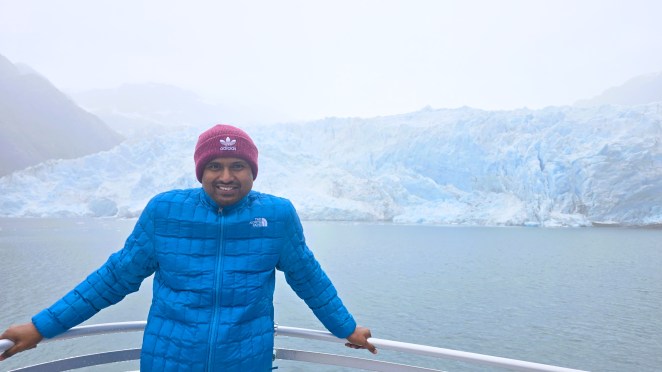
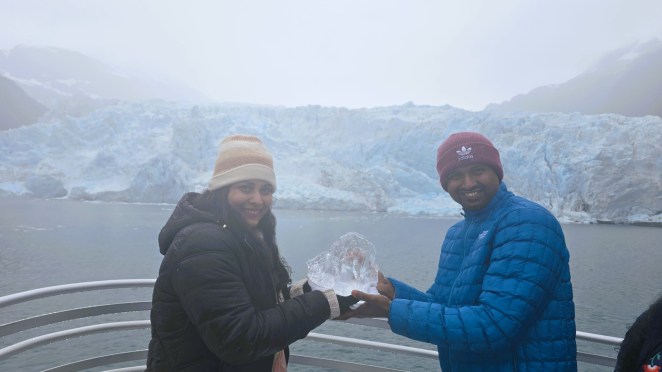
A massive wall of blue-white ice towering above the water, ancient, powerful, and alive. Our boat stopped a safe distance—about a hundred meters away—but even from that far, the glacier dominated the horizon. The deep grumbling echoed across the bay, and we witnessed a few pieces calve off. The sound was not gentle—it was a cannon-like roar that reverberated in your chest.
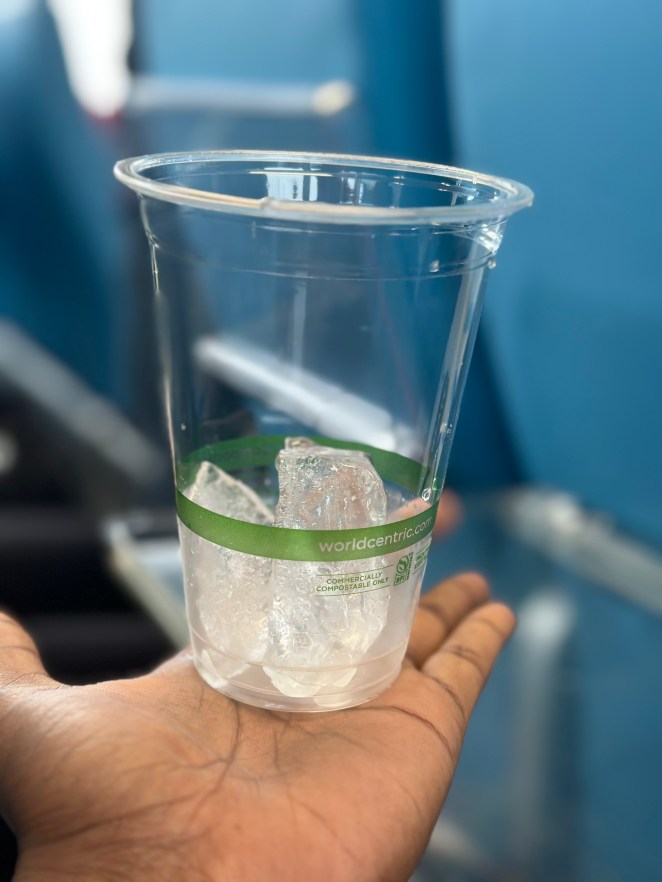
Ice chunks floated all around us, some the size of chairs, some of cars. A crew member scooped a piece out with a net and passed it around. To hold ice that may have been frozen for centuries—long before humans settled Alaska—was surreal.
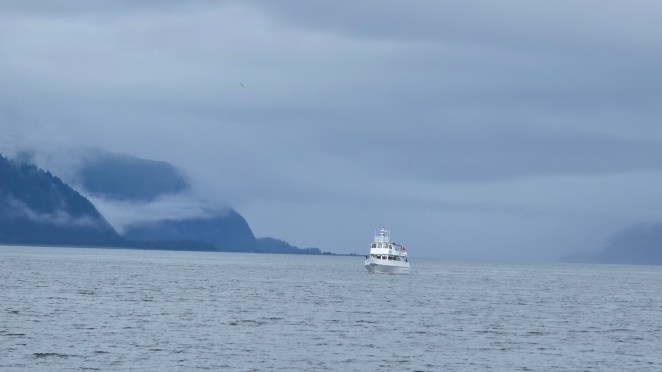
In the middle of this icy stillness, something hilarious happened. Another tour boat nearby had run out of hot chocolate, so they approached ours. Crew members from both boats leaned out, and a box of hot chocolate packets was dropped into the fishing net of the other boat.
We turned back around 2 PM, slowly reversing through the icy maze.
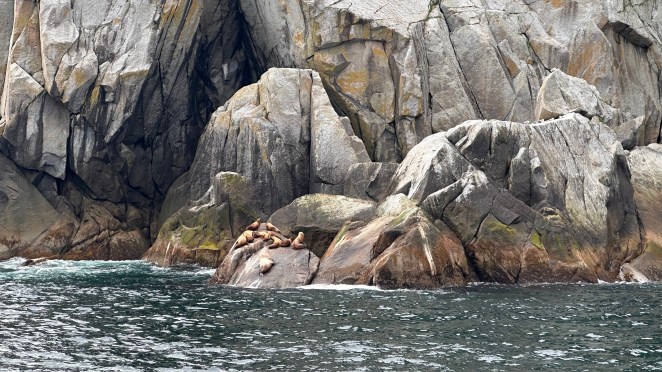
On our way back, we passed a small rocky island full of Steller sea lions—huge, golden-brown animals lounging like they owned the place. Their grunts echoed across the water, announcing their dominance in their loud, lazy way.
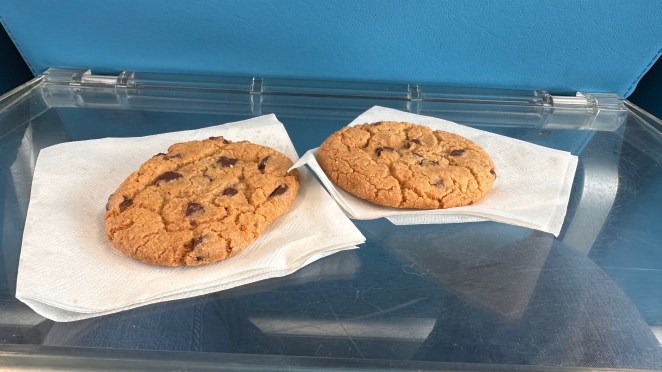
Throughout the tour, the crew members kept us well-fed. Lunch was warm, wholesome chicken burrito—perfect fuel after hours in the cold. Later in the afternoon, the crew passed out freshly baked cookies and more hot chocolate. After 7 unforgettable hours, we reached Seward again at around 4 PM, full of awe, content and hundreds of photos.

Exploring Seward Downtown – A Walk Through History
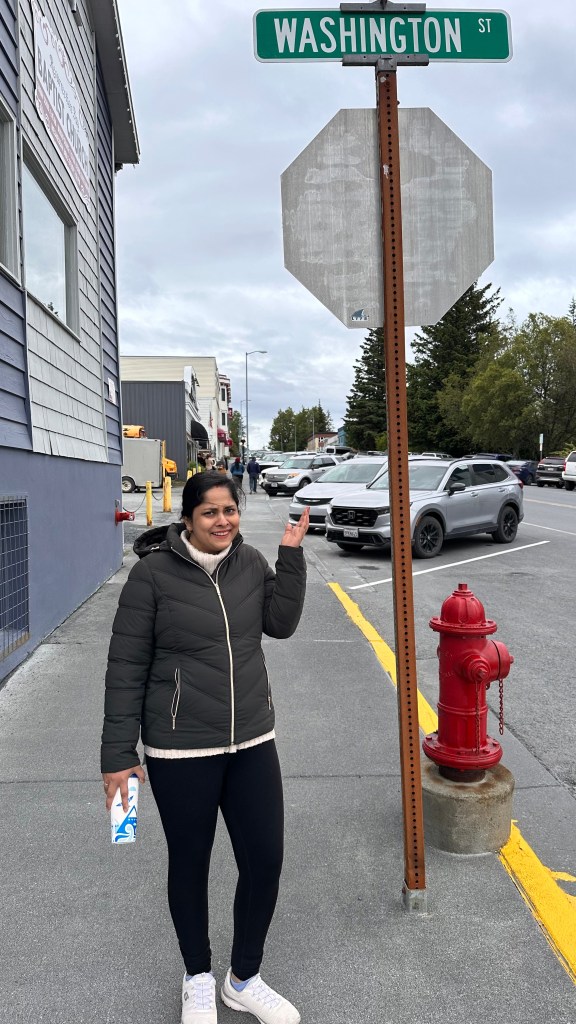
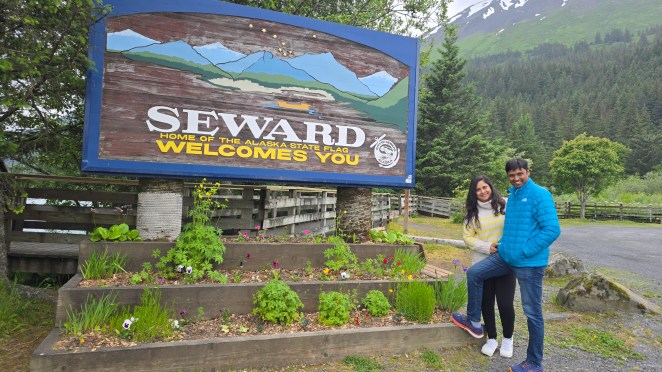
After refilling our RV’s fresh water tank, we headed into downtown Seward for an early evening stroll. Named after William H. Seward, the U.S. Secretary who purchased Alaska from Russia, Seward became a major port thanks to its ice-free harbor and strategic position between the mountains and the sea.
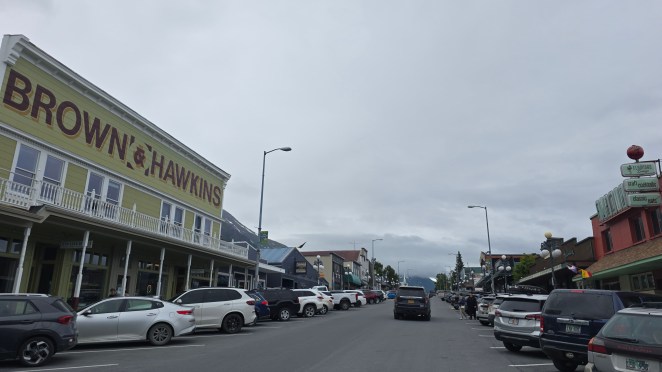
Seward’s avenues reflect the old social structure of the town. Fourth Avenue was for businesses, Third Avenue was where business owners lived, and Second Avenue was where workers lived. The architecture blends early 1900s wooden storefronts and modern art murals celebrating Alaska’s Indigenous culture and seafaring history. We stepped into Brown & Hawkins, a store that has been running since 1915, and Urbach’s, another century-old outfitter. These buildings feel preserved in time—creaky floors, vintage signage, and photographs of Seward through the decades.
Outside, we wandered near Two Lakes Park, a serene green space at the edge of town, and looked up toward the mountain famous for the annual July 4th Mount Marathon Race, one of the most challenging mountain races in North America that dates back to 1915. The race may be short—only 3.1 miles (5 km)—but it is famously grueling. The route goes straight up Mount Marathon, climbing about 3,022 feet in just over a mile.
The evening light made the mountains glow golden and emerald. Seward feels small but full of heart—an authentic Alaskan coastal town where fjords, forests, and history meet at every turn. We returned to our RV Campground around 7 PM, exhausted but filled with gratitude. The day had been a symphony of glaciers cracking, whales breathing, dolphins dancing, and stories carved into the cliffs of Resurrection Bay.
Day 3 reminded us of something simple yet profound: In Alaska, nature is not a backdrop—it’s the main character. And every hour spent here feels like a gift.



 Abhijeet Kumar Sinha